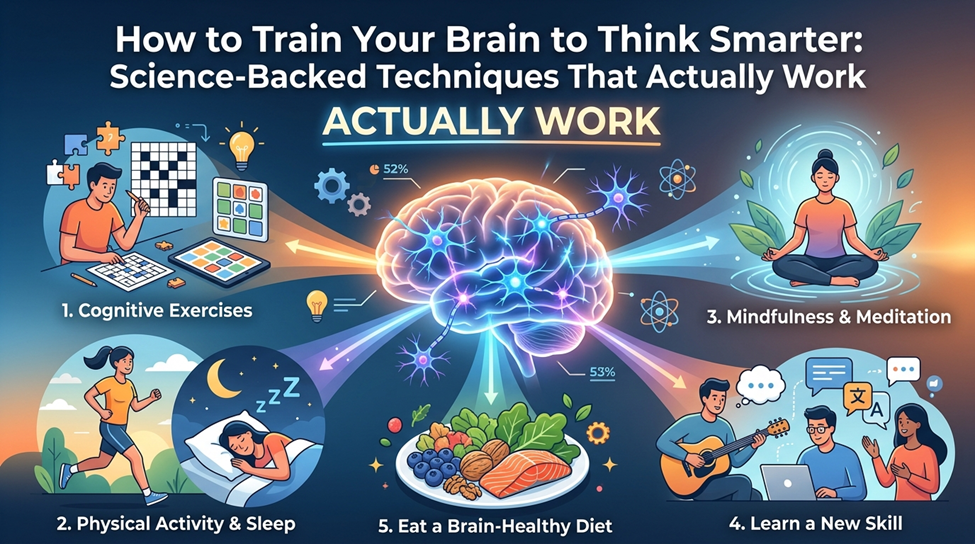
Thinking smarter is not about being “naturally intelligent.” Modern neuroscience shows that intelligence is not fixed—it is trainable. Your brain adapts based on how you use it, what you focus on, and the habits you build over time.
In fact, research in cognitive science confirms that the brain changes structurally through a process called neuroplasticity, meaning your thinking ability can improve with consistent mental training.
This article breaks down science-backed techniques that actually help you train your brain to think smarter, improve decision-making, and sharpen mental clarity in everyday life.
Just like the brain requires structured care and optimization to function efficiently, real-world systems also need proper maintenance and setup. For example, homeowners rely on professional providers offering heat pump services houston to ensure long-term system performance. Proper setup is equally important, which is why expert solutions like heat pump installation houston are essential for efficiency and reliability.
What Does It Mean to “Think Smarter”?
Thinking smarter does not mean knowing more facts. It means:
- Making better decisions with less effort
- Solving problems more efficiently
- Avoiding mental bias and emotional traps
- Learning faster and retaining information longer
- Thinking clearly under pressure
In simple terms, smart thinking is efficient thinking.
1. Train Your Brain Through Neuroplasticity (The Science of Change)
One of the most important discoveries in neuroscience is neuroplasticity—the brain’s ability to rewire itself.
This means every thought you repeat strengthens certain neural pathways.
For example:
- Practicing problem-solving improves logical thinking circuits
- Learning new skills strengthens memory networks
- Repeating focus habits improves attention control
Over time, your brain physically changes based on how you think.
2. Practice Deep Focus Instead of Multitasking
Studies consistently show that multitasking reduces productivity and weakens cognitive performance.
When you switch tasks frequently:
- Your brain wastes energy refocusing
- Memory retention decreases
- Error rates increase
Instead, practice deep focus sessions:
- Work on one task for 25–50 minutes
- Remove distractions (phone, tabs, notifications)
- Take short breaks before switching tasks
This strengthens your attention system and improves thinking speed over time.
3. Use the “Active Thinking” Method
Passive thinking (reading or watching without engagement) does not train the brain effectively.
Active thinking means:
- Asking questions while learning
- Summarizing ideas in your own words
- Teaching concepts to others
- Solving problems without looking at answers immediately
This method strengthens memory and reasoning pathways much faster.
4. Learn to Recognize Cognitive Biases
Your brain often uses shortcuts to make decisions quickly. These shortcuts are called cognitive biases, and they can lead to poor thinking.
Common examples include:
- Confirmation bias (only believing what you already think is true)
- Anchoring bias (relying too much on first information)
- Availability bias (judging based on recent events)
Understanding these biases helps you:
- Think more objectively
- Make better decisions
- Avoid emotional traps
This is one of the core principles behind critical thinking.
5. Improve Memory Through Spaced Repetition
Memory is not about repetition alone—it is about timing.
Spaced repetition is a scientifically proven method where you review information at increasing intervals.
For example:
- Day 1: Learn new concept
- Day 3: Review
- Day 7: Review again
- Day 14: Final review
This strengthens long-term memory retention significantly.
6. Sleep Is a Cognitive Superpower
Sleep is not rest for the brain—it is maintenance and optimization.
During sleep:
- Memories are consolidated
- Toxic waste is cleared from the brain
- Emotional regulation is restored
- Learning is processed and strengthened
Lack of sleep leads to:
- Poor decision-making
- Reduced attention span
- Weak memory formation
If you want to think smarter, improving sleep is non-negotiable.
7. Challenge Your Brain with Problem-Solving
The brain becomes sharper when it is challenged regularly.
You can train it by:
- Solving puzzles (logic, math, strategy games)
- Learning new skills (languages, coding, music)
- Asking “why” and “how” questions daily
When your brain struggles slightly, it grows stronger—similar to muscle training.
8. Practice Reflection Thinking (Most People Skip This)
Most people consume information but never reflect on it.
Reflection thinking means:
- Reviewing what you learned today
- Identifying mistakes in decisions
- Thinking about alternative outcomes
- Journaling ideas and insights
This improves:
- Self-awareness
- Decision quality
- Long-term memory
Even 10 minutes of reflection daily can significantly improve cognitive clarity.
9. Control Emotional Thinking for Better Logic
Emotions strongly influence decisions—often more than logic.
Stress, anger, and excitement can:
- Reduce rational thinking
- Increase impulsive decisions
- Narrow attention focus
To think smarter:
- Pause before reacting
- Practice mindfulness or breathing techniques
- Separate emotional response from analysis
This strengthens the prefrontal cortex—the brain region responsible for rational thinking.
10. Learn Continuously (Even Small Learning Counts)
The brain thrives on novelty.
When you learn something new:
- New neural connections form
- Existing pathways strengthen
- Cognitive flexibility improves
You do not need major learning sessions. Even:
- Reading articles
- Learning new vocabulary
- Watching educational content
…keeps your brain active and adaptive.
11. Use Mental Models to Think Better
Mental models are simple frameworks that help you understand the world.
Examples include:
- Cause and effect thinking
- First-principles thinking
- Cost-benefit analysis
- Systems thinking
Instead of reacting emotionally, mental models help you:
- Break problems into parts
- Analyze consequences
- Make structured decisions
This is how experts think differently from beginners.
12. Physical Exercise Improves Brain Performance
Exercise is not just for the body—it directly improves brain function.
It increases:
- Oxygen flow to the brain
- Memory performance
- Mood stability
- Focus and attention
Even 20–30 minutes of movement daily improves cognitive performance.
13. Reduce Mental Clutter (Information Overload)
Your brain has limited processing capacity.
Too much information leads to:
- Decision fatigue
- Reduced focus
- Poor memory retention
To reduce clutter:
- Limit unnecessary scrolling
- Organize tasks clearly
- Focus on one priority at a time
A clear mind thinks faster and more accurately.
14. Practice Mindfulness to Strengthen Awareness
Mindfulness is the ability to observe thoughts without reacting immediately.
Benefits include:
- Better emotional control
- Improved focus
- Reduced stress
- Enhanced decision-making
It trains your brain to slow down automatic reactions and think more consciously.
Final Thoughts
Training your brain to think smarter is not about intelligence—it is about consistency and mental habits.
Science shows that your brain is constantly changing based on how you use it. By applying techniques like deep focus, reflection, sleep optimization, cognitive awareness, and continuous learning, you can significantly improve how you think and solve problems.
Even real-world systems perform best when properly set up and maintained. That’s why services such as heat pump services houston and professional installation options like heat pump installation houston are important for long-term efficiency—just as consistent mental habits are essential for a high-performing mind.
