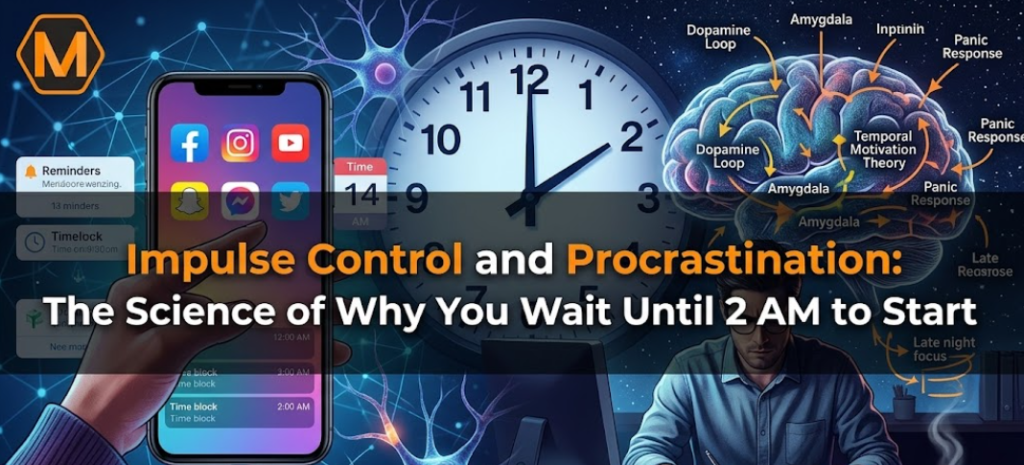
Impulse Control and Procrastination: The Science of Why You Wait Until 2 AM to Start
It is 1:45 AM. The house is silent, save for the hum of your laptop and the occasional distant siren. You have a massive project due in exactly seven hours, yet you have spent the last three hours researching the history of sourdough bread or scrolling through “day in the life” vlogs. This isn’t just bad time management; it’s a biological battle. Most students believe they procrastinate because they are “lazy,” but science suggests something far more complex. It is a fundamental glitch in how the human brain processes emotion and time.
The struggle often starts when a task feels overwhelming or technically exhausting. For instance, if you are staring at a complex blueprint and realize you need engineering assignment help, navigating to a trusted resource like myassignmenthelp can provide the structural clarity needed to stop the spiral of avoidance. Procrastination is actually an “emotion regulation” problem, not a “time management” problem. Your brain’s amygdala—the part responsible for the “fight or flight” response—sees that difficult essay or calculation as a literal threat to your well-being. To protect you from the stress of the task, your brain hijacks your focus and directs it toward something “safe” and easy, like social media.
The Biological War: Prefrontal Cortex vs. Amygdala
To understand why we wait until the dead of night to start working, we have to look at the “Biological Tug-of-War.” Inside your head, two main players are fighting for control:
- The Prefrontal Cortex (The Planner): This is the logical, evolved part of your brain. It understands that if you don’t start now, you will fail. It thinks about the future, your career, and your GPA.
- The Limbic System (The Pleasure Seeker): This is the ancient, impulsive part of the brain. It doesn’t care about next week; it only cares about “right now.” It wants dopamine, and it wants it immediately.
When you procrastinate, the Limbic System wins. It convinces you that “Future You” will have more energy and more “vibes” to get the work done. However, “Future You” is just “Present You” but more tired and more stressed. This creates a loop of guilt that actually makes the task harder to start the next time.
The Psychology of Academic Avoidance
Psychologists often categorize procrastinators into different types based on their underlying fears. Understanding which “type” you are can help you dismantle the habit.
| Procrastinator Type | Core Motivation | The “2 AM” Trigger |
| The Perfectionist | Fear of being judged or failing. | Waits until the last minute so they have an “excuse” (lack of time) if the work isn’t perfect. |
| The Dreamer | Dislikes the tedious details of execution. | Stays in the “planning” phase because doing the actual work is too “real.” |
| The Defier | Rebels against external schedules. | Uses 2 AM as a way to reclaim “control” over their own time. |
| The Overdoer | Takes on too much and gets paralyzed. | The sheer volume of work causes “Executive Dysfunction” and total freeze. |
Export to Sheets
Temporal Motivation Theory: The Math of Late-Nights
Why does the “spark” to work finally hit at 2 AM? Scientists call this Temporal Motivation Theory. Essentially, your motivation to do a task is based on four things: how much you value the reward, how much you expect to succeed, how impulsive you are, and—most importantly—how much time you have left.
As the deadline gets closer, the “Delay” factor in this equation disappears. When the deadline is two weeks away, the “Impulsive” brain doesn’t feel the threat. But when the deadline is five hours away, the fear of failure finally outweighs the desire to scroll TikTok. The adrenaline of the “crunch time” finally forces your brain to focus. For technical students, this pressure is often doubled. If you find yourself stuck on a coding logic error at midnight, searching for python programming assignment help can be the specific intervention that breaks the paralysis and gets the code running before the sun comes up.
The “Dopamine Loop” and Digital Distractions
In 2026, the battle against procrastination is harder than ever because of the “Dopamine Economy.” Apps are designed to exploit the Limbic System. Every notification, “like,” or short-form video release triggers a tiny hit of dopamine. Compared to the slow, difficult process of writing a thesis or solving calculus, the phone provides instant gratification.
When you are stressed about an assignment, your brain is “starving” for a mood boost. The phone becomes a digital drug that numbs the anxiety of the looming deadline. This is why you find yourself “doom-scrolling” even when you aren’t actually enjoying the content. You are simply trying to escape the negative emotions associated with your work.
Why “2 AM” is a Psychological Trap
There is a specific phenomenon known as Revenge Bedtime Procrastination. This happens when students feel they have no control over their daytime schedule—classes, work, and family obligations take up every hour. When night falls, you stay awake not because you are productive, but because it is the only time you feel “in control” of your life.
However, this creates a dangerous cycle of sleep deprivation. When you are tired, your impulse control is the first thing to go. A brain with four hours of sleep has a very weak Prefrontal Cortex, making it almost impossible to say “no” to distractions the following day. You aren’t just losing sleep; you are losing your ability to fight off future procrastination.
Breaking the Executive Dysfunction Loop
If you want to stop the 2 AM cycle, you have to stop treating yourself like a robot. You cannot “force” focus through sheer willpower alone because willpower is a finite resource that runs out by 5 PM. Instead, you need to lower the “Activation Energy” of the task.
1. The 5-Minute Rule
Tell yourself you will only work for five minutes. Often, the hardest part is the “transition” from resting to working. Once the “Planning Brain” takes over, it’s much easier to keep going.
2. Environment Design
If your phone is next to you, your Limbic System will always choose it over a textbook. Put the phone in another room. Make the “bad” habit hard to do and the “good” habit easy to start. This is called “Choice Architecture.”
3. Self-Compassion
Research shows that students who forgive themselves for procrastinating on the last assignment are actually less likely to procrastinate on the next one. Guilt is a stressor, and stress triggers the Amygdala to hide from work again.
The Science of “Deep Work” and Flow
When you finally get past the “impulse” to check your phone, you enter a state called Flow. This is where time seems to disappear, and your productivity spikes. To get into Flow, the challenge of the task must match your skill level. If a task is too hard, you get anxious and quit. If it is too easy, you get bored and scroll.
This is why breaking a 2,000-word essay into “Micro-Tasks” (like just writing the first three citations) is so effective. It lowers the anxiety levels, allowing the Prefrontal Cortex to maintain control without the Amygdala sounding the alarm bells.
Managing the “Cognitive Load” Funnel
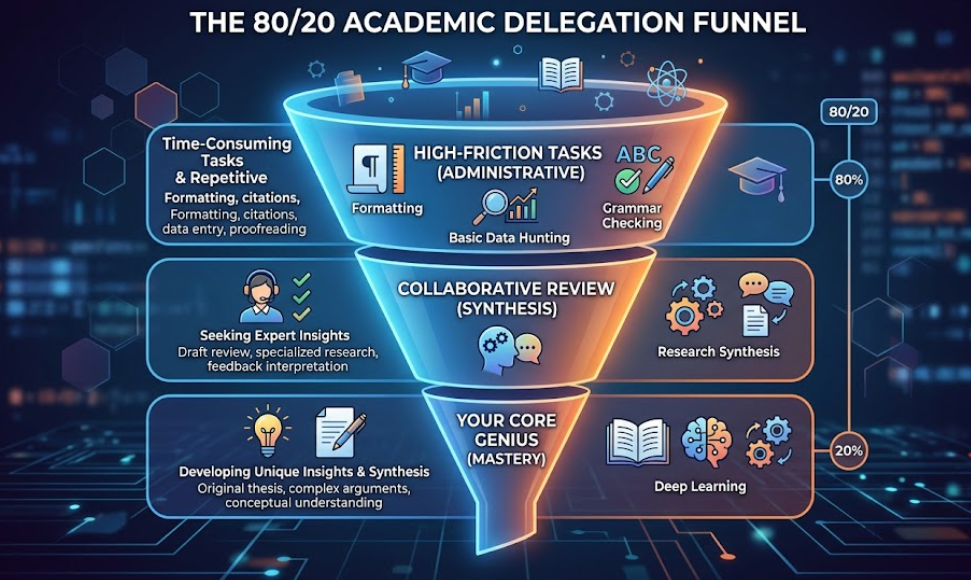
Every decision you make during the day—from what to wear to what to eat—uses up your mental energy. By the time you sit down to do your heaviest academic work, your “decision tank” is empty. This is why many high-achieving students use a “Funnel” strategy. They automate the boring parts of their life so they can save their “Deep Work” energy for their most important research.
The Long-Term Impact of Chronic Procrastination
While the “2 AM adrenaline rush” might get the job done occasionally, chronic procrastination has a “Compounding Cost.” It leads to higher levels of cortisol (the stress hormone), which can physically shrink the Prefrontal Cortex over time. This makes it even harder to regulate impulses in the future.
Furthermore, “Panicked Work” is rarely your best work. While you might pass the class, you aren’t truly learning or synthesizing the information. You are simply performing “Academic Survival.” To move from survival to mastery, you must move your work hours from the “Panic Zone” (2 AM) to the “Power Zone” (when your brain is fresh).
Strategic Delegation: The Professional’s Secret
By delegating the repetitive, high-stress parts of academic life—like formatting, deep-dive data hunting, or verifying complex citations—you protect your mental health. This isn’t “taking the easy way out”; it is strategic energy management. It allows you to spend your best hours learning the material rather than fighting with a bibliography or a broken line of code.
Professional researchers and CEOs do this constantly. They focus on the “High-Value” logic and outsource the “High-Friction” administrative tasks. For a student, this might mean using a citation generator or getting expert feedback on a draft to ensure they aren’t wasting hours on a wrong path.
Summary: Moving From “Panic” to “Purpose”
Waiting until 2 AM is a biological response to stress, but it doesn’t have to be your permanent reality. By understanding that your brain is trying to protect you from “uncomfortable” emotions, you can start to use tools that lower that discomfort. Whether it’s using the 5-minute rule, organizing your workspace for digital minimalism, or reaching out for expert research assistance when the technical load becomes too heavy, the goal is to reduce the friction between you and your goals.
The next time you find yourself awake at 2 AM, don’t beat yourself up. Recognize the “Amygdala Hijack” for what it is, take a deep breath, and break the very next task into the smallest possible piece. You don’t need more willpower; you just need a better strategy to manage your brain’s natural impulses. Shift your perspective from “I have to do this” to “I am going to start this for five minutes,” and watch how your brain’s biological defense mechanisms slowly begin to work with you, rather than against you.
Frequently Asked Questions
Why do I feel more productive late at night?
This often happens because the approaching deadline finally triggers enough adrenaline to override your brain’s natural avoidance. Additionally, the lack of daytime distractions creates a quiet environment that makes it easier for some to enter a “flow state,” even if it stems from urgency.
Is procrastination caused by poor time management?
Not necessarily. Research shows that procrastination is primarily an emotional regulation issue. Your brain avoids a task to escape the immediate stress or anxiety associated with it, choosing short-term mood improvement over long-term goals.
What is the “5-minute rule” for starting tasks?
The 5-minute rule is a cognitive hack where you commit to working on a project for only five minutes. Because the hardest part of any task is the transition from rest to action, this low-pressure start often breaks the initial barrier of resistance.
How does sleep deprivation affect my focus?
When you lose sleep, the prefrontal cortex—the part of the brain responsible for logical thinking and impulse control—weakens. This makes you more likely to give in to distractions and less capable of handling complex problem-solving the following day.
About The Author
Min Seow is a dedicated content strategist and academic researcher at myassignmenthelp, where they specialize in bridging the gap between complex psychological theory and practical student success. With a focus on high-readability and human-centric storytelling, Min provides actionable insights to help learners navigate the pressures of modern education.
