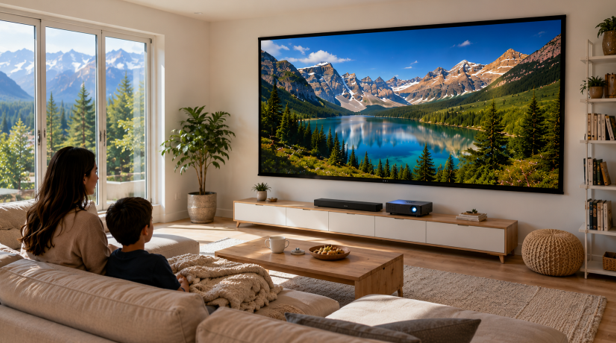
Not every great viewing moment happens after sunset. Weekend sports, afternoon cartoons, fitness videos, news broadcasts, and casual streaming often take place while the room is still bright. That creates a different challenge from the classic dark-room home theater. The goal is not simply to produce a large image. It is to create an image that remains clear, colorful, and comfortable while everyday life continues around it.
Before upgrading a projector or screen, it helps to understand how daylight behaves in the room. A window directly opposite the screen can be more disruptive than one positioned to the side. Glossy furniture, glass tables, and polished floors may create reflections that make darker scenes harder to follow. Even white walls and pale ceilings can bounce light back toward the screen and reduce perceived contrast.
Observing the room throughout the day is therefore one of the most useful first steps. The lighting conditions at 10 a.m. may be very different from those at 4 p.m. Understanding those changes can prevent an expensive upgrade from solving the wrong problem.
Brightness Is Only Part of the Story
Brightness matters, but it is not a magic fix by itself. A brighter projector can help, yet the screen surface, room layout, and viewing habits still matter. If direct sunlight hits the screen, almost any image will suffer. If lamps reflect into viewers’ eyes, the picture can feel less comfortable even when the projector is capable.
This is why many homeowners start by making small room improvements. Curtains, blinds, screen placement, and lamp position can make a surprising difference. Once the light is under control, a bright room UST projector has a better chance to show its strengths in the kind of room people actually use during the day.
Color Performance Changes the Experience
Daylight does not only reduce contrast. It can also make colors feel flatter. Sports fields, animated films, nature documentaries, and games all depend on color to feel lively. If the image looks dull, viewers may not describe the problem technically, but they will feel it.
Laser projection has become interesting in this context because color performance can be part of the everyday viewing experience, not just a spec for enthusiasts. A 4K RGB triple laser projector can appeal to viewers who care about both resolution and richer color reproduction, especially when the room is used for varied content.
Match the Screen to the Room
A projection screen is not simply a neutral piece of white fabric. Its surface influences how much light reaches the viewer, how ambient light affects contrast, and how evenly the image appears across different seating positions.
In brighter spaces, an ambient light rejecting screen may help reduce the effect of light coming from certain directions and preserve perceived contrast. This can be particularly valuable in living rooms where people do not want to close every curtain or turn off every lamp whenever they watch something.
However, the screen still needs to match the projector type and room layout. A surface that performs well with one projector or lighting arrangement may not be suitable for another. Viewing angle, screen gain, projector placement, and the direction of the room’s main light sources should all be considered together.
Screen height is equally important. If the image is positioned too high, viewers may experience neck or eye strain during longer sessions. If it sits too low, a media cabinet, soundbar, coffee table, or people moving through the room may block part of the picture.
The largest possible screen is not always the most comfortable choice. A well-proportioned image at the correct height often creates a better experience than an oversized screen that forces viewers to look upward or sit too close.
Think About What You Watch Most
Someone who mainly watches films at night has different needs from someone who watches sports on Sunday afternoon. A gamer may care about responsiveness and contrast. A family may care about easy operation and a picture that still looks good when people are moving around the room.
The smartest upgrade begins with those habits. Make a list of the times of day the room is used, the type of content watched most often, and the lighting conditions that cannot realistically change. From there, it becomes easier to choose equipment that solves real problems instead of chasing numbers that may not matter in daily life.
Daylight viewing is not about defeating the sun. It is about designing a room and setup that work with realistic conditions. When brightness, color, screen choice, and placement support each other, the entertainment space becomes useful far beyond traditional movie night.
Test With the Content You Actually Watch
A showroom clip can look impressive and still tell you very little about daily use. Before judging a setup, test the kinds of content that matter most in the room. Try a daytime match, a dark drama, a colorful animated film, a news broadcast, and a game if gaming is part of the household routine. Each one reveals a different weakness or strength.
This kind of testing also prevents overbuying in the wrong direction. A person who watches mostly sports in a bright family room may need different priorities from someone who watches films late at night. The better the setup matches real viewing habits, the less likely it is to disappoint after the novelty wears off.
It is also worth checking the room at the exact time viewing usually happens. A Saturday afternoon sports test may reveal glare that never appears during an evening movie. A weekday morning workout may show that the screen needs a different brightness setting. These practical tests make the final setup more reliable.
The strongest daylight-friendly rooms are not built around one heroic specification. They are built around layers: controlled light, thoughtful placement, suitable screen material, and projection hardware that matches the routine. When those layers work together, daytime viewing feels intentional rather than compromised.
