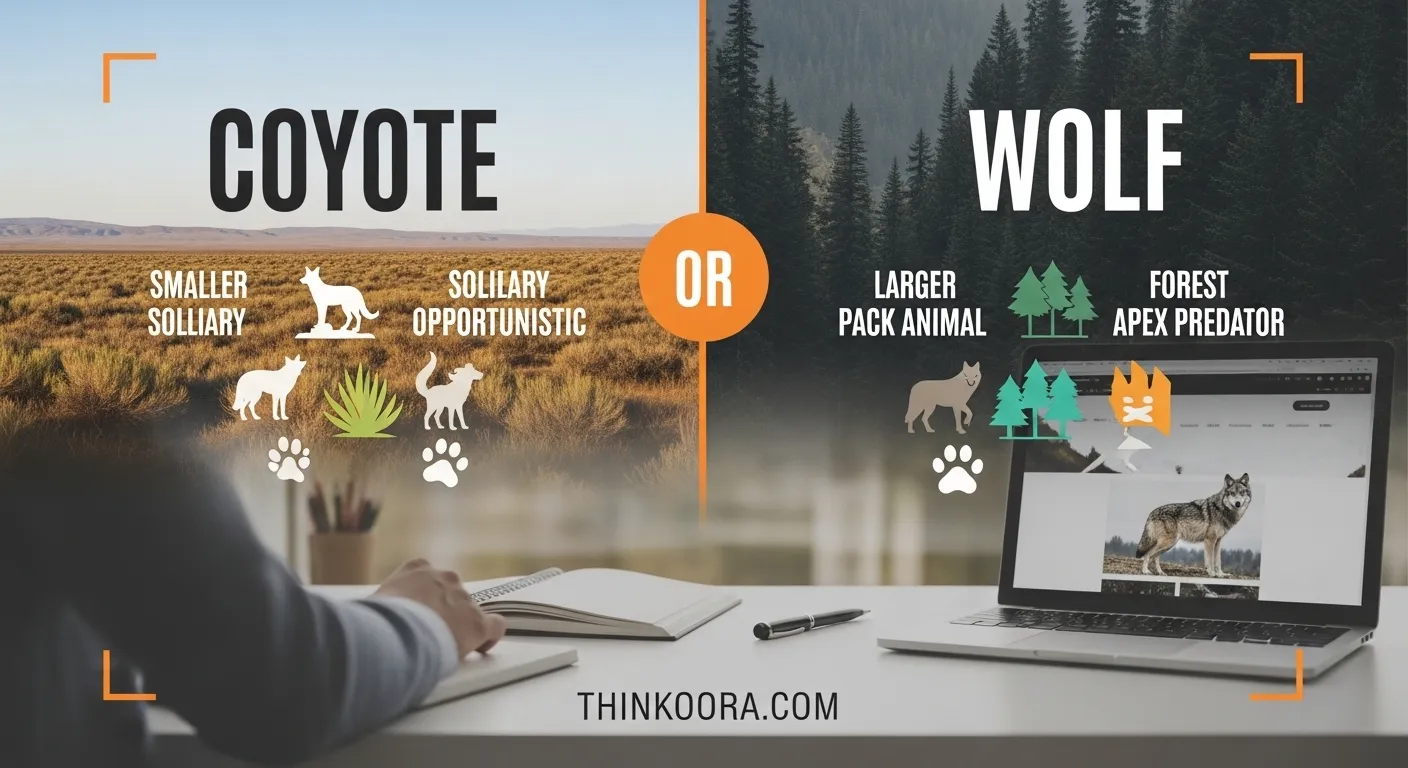
Have you ever seen a wild canine and wondered: Is it a coyote or a wolf?
You’re not alone.
Many people search for coyote or wolf because these animals look similar at first glance.
Both belong to the same family, both howl, and both live in the wild.
But here’s the truth: they are very different in size, behavior, and habitat.
This confusion often happens when people see videos online, read news reports, or spot an animal in rural areas.
Knowing the difference can help you stay safe, understand wildlife better, and avoid misinformation.
In this guide, you’ll learn the key differences, simple ways to identify each animal, and when to use the correct term.
We’ll also explore language usage, common mistakes, and real-world examples.
Let’s clear up the confusion once and for all.
Coyote or Wolf – Quick Answer
A coyote is smaller, lighter, and more adaptable.
A wolf is larger, stronger, and lives in structured packs.
Simple Examples
- If the animal looks like a large dog with long legs and narrow face → it’s likely a coyote
- If it looks big, thick, and powerful with a wide head → it’s a wolf
Quick Comparison
| Feature | Coyote | Wolf |
| Size | Small (20–50 lbs) | Large (70–150 lbs) |
| Face Shape | Narrow | Broad |
| Behavior | Often alone or in pairs | Lives in packs |
| Habitat | Cities & rural areas | Remote forests & wilderness |
| Sound | High-pitched yips | Deep howls |
The Origin of Coyote or Wolf
The confusion between coyote or wolf is not about spelling it’s about biological similarity and shared ancestry.
Coyote – Origin
- The word coyote comes from the Aztec word coyotl
- It entered English through Spanish
- Coyotes are native to North America
Wolf – Origin
- The word wolf comes from Old English wulf
- It has Germanic roots
- Wolves have lived across Europe, Asia, and North America
Why the Confusion Exists
- Both animals belong to the Canidae family
- They share similar features:
- Fur color
- Body shape
- Howling sounds
However, they evolved differently and adapted to different environments.
British English vs American English Spelling
Good news: there is no spelling difference between British and American English for coyote or wolf.
Both regions use the same words:
- Coyote (not coyot or coyotte )
- Wolf (not wolfe in modern usage)
Comparison Table
| Word | American English | British English |
| Coyote | Coyote | Coyote |
| Wolf | Wolf | Wolf |
Note
Unlike words like color/colour, these animal names remain unchanged globally.
Which Spelling Should You Use?
Since there is no spelling variation, the real question is:
👉 Which animal should you refer to?
Use Coyote when:
- Talking about smaller wild canines
- Referring to animals seen in urban or suburban areas
- Writing about North American wildlife
Use Wolf when:
- Describing large pack animals
- Talking about wilderness or forests
- Referring to stronger predators
Audience-Based Advice
- US audience: Use both terms correctly based on context
- UK/Commonwealth: Same usage applies
- Global audience: Add a short explanation if needed
Common Mistakes with Coyote or Wolf
Many people mix these up. Here are the most common errors:
❌ Mistake 1: Calling a coyote a wolf
✔️ Fix: Check size and behavior first
❌ Mistake 2: Assuming all howling animals are wolves
✔️ Fix: Coyotes howl too but their sound is sharper
❌ Mistake 3: Using the terms interchangeably
✔️ Fix: They are different species
❌ Mistake 4: Spelling errors like coyot
✔️ Fix: Always write coyote
❌ Mistake 5: Thinking coyotes are baby wolves
✔️ Fix: They are fully grown animals, not young wolves
Coyote or Wolf in Everyday Examples
Here’s how you might use these words in real life:
In Emails
- We spotted a coyote near the farm last night.
- Officials confirmed a wolf sighting in the forest.
In News
- A wolf pack has returned to the region.
- Urban areas report rising coyote activity.
On Social Media
- Is this a coyote or wolf? Help me identify!
- That howl sounds like a wolf, not a coyote.
In Formal Writing
- The coyote population has expanded into urban zones.
- The wolf ecosystem plays a key role in biodiversity.
Coyote or Wolf – Google Trends & Usage Data
Search interest for coyote or wolf is high in regions where both animals exist.
Popular Countries
- United States
- Canada
- Parts of Europe
Search Intent
People search this keyword to:
- Identify animals from videos
- Learn survival tips
- Understand wildlife behavior
Usage Context
- Wildlife education
- News reports
- Outdoor safety guides
Trend Insight
- Coyote searches rise in urban-related topics
- Wolf searches increase in documentaries and conservation topics
Comparison Table – Coyote vs Wolf
| Feature | Coyote | Wolf |
| Scientific Name | Canis latrans | Canis lupus |
| Weight | 20–50 lbs | 70–150 lbs |
| Height | Smaller | Taller |
| Pack Behavior | Solo or small groups | Large structured packs |
| Habitat | Cities, deserts, plains | Forests, mountains |
| Diet | Omnivorous | Mostly carnivorous |
| Speed | Fast and agile | Strong and enduring |
FAQs
1. How can I tell a coyote from a wolf?
Look at size and face shape. Coyotes are smaller with narrow faces. Wolves are larger with broad heads.
2. Are coyotes dangerous like wolves?
Coyotes are less dangerous and avoid humans. Wolves can be more dangerous but rarely attack.
3. Do coyotes and wolves live together?
Not usually. Wolves may even chase or kill coyotes.
4. Can a coyote turn into a wolf?
No. They are different species.
5. Which one howls louder?
Wolves have deeper, louder howls. Coyotes make higher-pitched sounds.
6. Are coyotes found in cities?
Yes. Coyotes adapt well to urban areas.
7. Are wolves endangered?
Some wolf populations are protected due to past decline.
Conclusion
Understanding the difference between coyote or wolf is easier than it seems.
Coyotes are smaller, more flexible, and often live near humans.
Wolves are larger, stronger, and prefer remote wilderness.
While they share the same family, their behavior, size, and lifestyle set them apart clearly.
There is no spelling confusion in English, but there is a big difference in meaning.
Using the correct term helps in writing, conversation, and even safety awareness.
If you ever spot a wild canine, remember:
- Check the size
- Observe the behavior
- Listen to the sound
These simple clues can help you identify it correctly.
In the end, knowing whether it’s a coyote or wolf makes you more informed and confident whether you’re reading, writing, or exploring nature.
Read More:
Griefing vs Grieving – Don’t Confuse These Two Words
