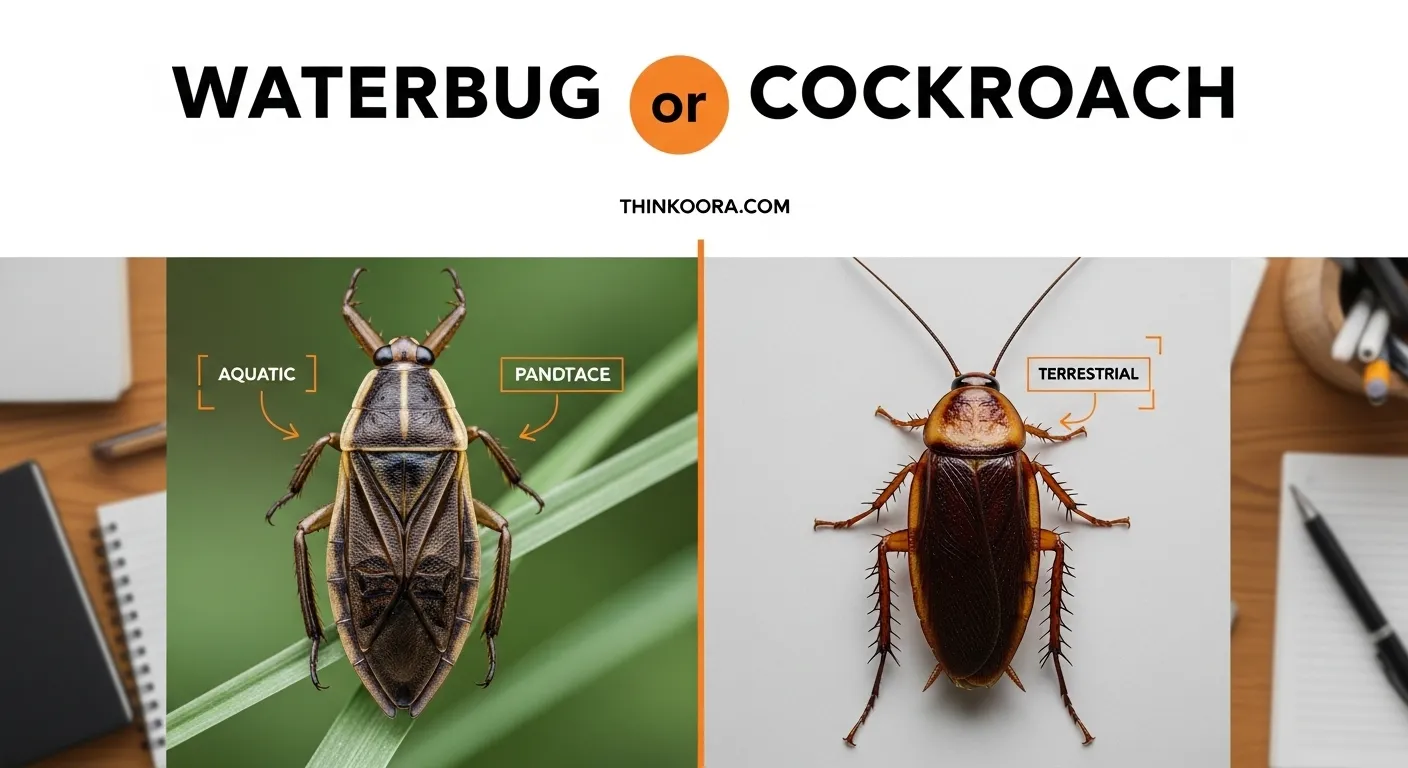
Many people often get confused between the terms waterbug or cockroach.
While both words are commonly used in conversation, news, and online searches, they do not always mean the same thing.
Some use waterbug thinking it is a type of cockroach, while others use cockroach for any insect they find in the kitchen.
This confusion is why people frequently search for waterbug or cockroach to clarify which word is correct, when to use each, and how the terms vary regionally.
The distinction is important because the two words can refer to different species or contexts.
Misusing them can lead to misunderstandings in casual conversation, pest control discussions, or academic writing.
Understanding the correct usage helps writers, students, and homeowners communicate clearly about insects and their behaviors.
This article will provide a quick answer, explore the origin of the words, compare British and American usage, explain common mistakes, and show examples in everyday life.
By the end, you’ll know exactly when to use waterbug and when cockroach is the correct term.
Waterbug or Cockroach – Quick Answer
✅ Quick Answer:
- Cockroach is a general term for insects of the order Blattodea. They are common household pests.
- Waterbug usually refers to a large species of cockroach found in damp areas or sometimes to aquatic insects unrelated to cockroaches.
Examples:
- The kitchen was full of cockroaches.
- I saw a giant waterbug near the pond.
💡 Key tip: In casual US English, “waterbug” is often used to describe large cockroaches, but scientifically, not all waterbugs are cockroaches.
The Origin of Waterbug or Cockroach
Cockroach comes from the Spanish word cucaracha, adopted into English in the 17th century. It originally referred to common household pests.
Waterbug originated as a descriptive English term for insects found in water or damp areas. Over time, the term became loosely associated with certain large cockroach species, particularly in the United States.
The spelling difference exists only because English borrows words from multiple languages. Both words are correct but are used in different contexts.
British English vs American English Spelling
There is no major spelling difference, but usage varies regionally.
| Word | British English Usage | American English Usage |
| Cockroach | ✅ Standard term for all household species | ✅ Standard term for all species |
| Waterbug | ❌ Rare, usually refers to aquatic insects | ✅ Commonly used for large cockroaches in homes |
💡 Tip: In the US, people often call American cockroaches “waterbugs”, especially in the South.
Which Spelling Should You Use?
Always spell cockroach and waterbug correctly. Choice depends on audience and region:
- 🇺🇸 US audience → cockroach for general pests, waterbug for large species in homes
- 🇬🇧 UK audience → cockroach is used; waterbug is rarely used
- 🌍 Global audience → Use cockroach for clarity in formal writing
Common Mistakes with Waterbug or Cockroach
❌ Frequent Errors
- Using waterbug for any cockroach species
- Confusing waterbugs with aquatic insects unrelated to cockroaches
- Misspelling cockroach as cockroack
✅ Corrections
- Large cockroaches in basements: waterbug (informal US)
- Any household cockroach: cockroach
- Pond insects: waterbug (true aquatic species)
Waterbug or Cockroach in Everyday Examples
📧 Emails
- Please check the kitchen for cockroaches.
- A waterbug was spotted near the sink.
📰 News
- City reports increase in cockroach sightings.
- Waterbugs found in local ponds may indicate high moisture levels.
📱 Social Media
- Ugh, just saw a huge waterbug in my bathroom!
- Cockroach infestation horror stories are trending online.
📄 Formal Writing
- ❌ Avoid using “waterbug” when scientific accuracy is required
- ✅ Use cockroach species of the order Blattodea
Waterbug or Cockroach – Google Trends & Usage Data
Search data shows:
- Cockroach has a higher global search volume
- Waterbug searches are mostly US-specific, often informal
- Highest interest is from homeowners, pest control enthusiasts, and students
This confirms that cockroach is the safe, universally understood term.
Comparison Table: Waterbug vs Cockroach
| Term | Correct | Meaning | Usage |
| Cockroach | ✅ Yes | All household pests in order Blattodea | Universal, formal & informal |
| Waterbug | ✅ Partial | Large cockroaches (US) or aquatic insects | Informal, US-specific |
| Waterbug | ❌ Incorrect | Any cockroach globally | Misleading outside US |
FAQs
1. Are waterbugs and cockroaches the same?
Sometimes. Large cockroaches in the US are called waterbugs, but not all waterbugs are cockroaches.
2. Which term is better for formal writing?
Always use cockroach.
3. Why do Americans call cockroaches waterbugs?
Because large cockroaches often live in damp basements, making “waterbug” a descriptive term.
4. Are waterbugs found in ponds dangerous?
No, true aquatic waterbugs are harmless.
5. Is there a British difference?
Yes, in the UK, people almost always use cockroach.
6. Can I use waterbug in school essays?
Only if you clarify the species; otherwise, use cockroach.
7. How to spell cockroach correctly?
C-O-C-K-R-O-A-C-H ✅
Conclusion
The terms waterbug or cockroach often confuse English learners and casual speakers.
While both words exist, cockroach is the universally understood, scientifically correct term.
Waterbug is mainly used in informal American English to describe large cockroaches, but it can also refer to aquatic insects unrelated to cockroaches.
For clarity, always use cockroach in formal, academic, or international writing.
Reserve waterbug for informal US contexts or when describing specific large cockroaches.
Understanding the difference prevents confusion, ensures accurate communication, and makes your writing professional and precise.
Remember: ✅ Cockroach = universal term, Waterbug = informal US usage for large species.
Read More:
Belive or Believe – Which Spelling Is Correct? (Complete Guide)

I am Samuel Wright, a writer who loves helping people understand English grammar, spelling, and word usage clearly.