Have you ever written a sentence and stopped to wonder: Should I write the boat sank or the boat sunk?
Many English learners and even native speakers struggle with the sunk or sank confusion.
Both words come from the verb sink, which means to go down below the surface of water or another substance.
But the tricky part is that both forms exist, yet they are used in different grammatical situations.
People search for sunk or sank because they want to know:
- Which word is grammatically correct
- When to use sank vs sunk
- Whether there is a difference in British and American English
- Which version is best for formal writing
The confusion happens because English verbs have different past forms. Some verbs use one past form, while others have both simple past and past participle forms.
In this article, you’ll learn the clear difference between sank and sunk, their origin, common mistakes, and how to use them correctly in everyday writing.
Sunk or Sank – Quick Answer
The difference between sunk or sank is simple.
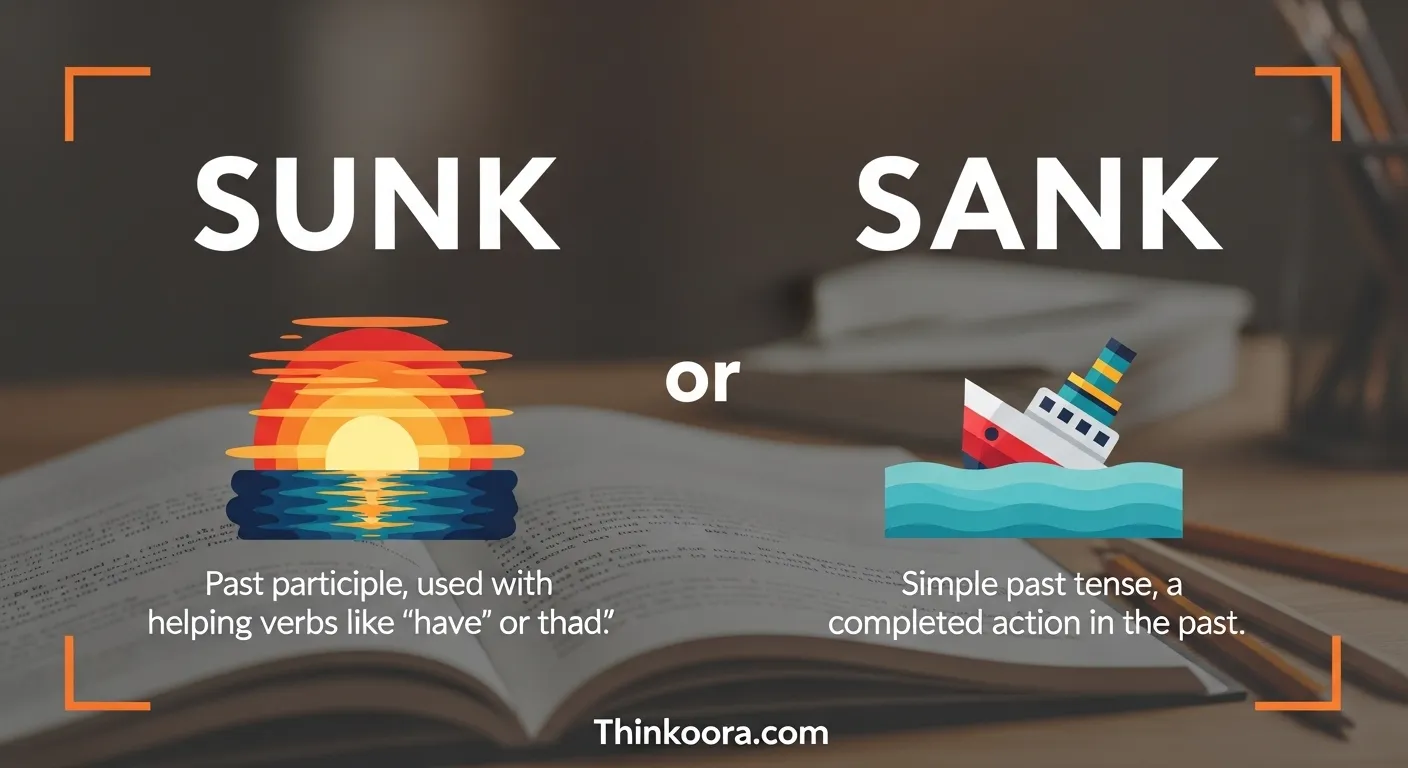
- Sank → simple past tense
- Sunk → past participle (used with has, have, had)
Examples
Sank (Past Tense)
- The ship sank during the storm.
- The stone sank to the bottom of the lake.
- My heart sank when I heard the news.
Sunk (Past Participle)
- The ship has sunk near the coast.
- The treasure had sunk deep underwater.
- The boat has sunk after hitting a rock.
Simple Rule
- Use sank for past tense alone
- Use sunk with has / have / had
Example:
- Correct: The boat sank yesterday.
- Correct: The boat has sunk.
- Incorrect: The boat has sank.
The Origin of Sunk or Sank
The words sunk or sank come from the Old English verb sincan.
This verb meant:
- to fall
- to descend
- to go underwater
In Old English, verbs often changed form depending on tense.
Over time, the verb sink developed three main forms:
| Verb Form | Example |
| Base form | sink |
| Past tense | sank |
| Past participle | sunk |
This pattern is called a strong verb pattern in English grammar.
Similar verbs follow this same pattern:
- drink – drank – drunk
- ring – rang – rung
- sing – sang – sung
Because of this pattern, sank and sunk both survived in modern English, but they serve different grammatical roles.
British English vs American English Spelling
Unlike many English words, sunk and sank are not spelling variations between British and American English.
Both British English and American English follow the same grammar rule.
Key Point
The difference is grammatical, not regional.
However, in casual speech some people mistakenly use sunk instead of sank, especially in American informal conversation.
Example of incorrect informal usage:
- The ship sunk yesterday. ❌
Correct grammar:
- The ship sank yesterday. ✔
Comparison Table
| Form | Usage | Example |
| Sank | Simple past tense | The ship sank in 1912 |
| Sunk | Past participle | The ship has sunk |
| Sank | Used without helper verbs | The stone sank |
| Sunk | Used with has/have/had | The stone has sunk |
Which Spelling Should You Use?
The correct choice depends on sentence structure, not country.
Use Sank When
- Writing past tense
- Describing a completed action
- No helping verb is used
Examples:
- The Titanic sank in 1912.
- The ball sank in the water.
- His hopes sank after the interview.
Use Sunk When
- Using has / have / had
- Writing present perfect
- Writing past perfect
Examples:
- The boat has sunk near the harbor.
- The city had sunk into silence.
- The price has sunk drastically.
Audience-Based Advice
US Writers
- Follow standard grammar: sank (past), sunk (participle).
UK / Commonwealth Writers
- Same grammar rule applies.
Global Audience
- Stick with the standard grammar rule for clarity.
Common Mistakes with Sunk or Sank
Many writers confuse sunk or sank because both sound similar.
Here are the most common mistakes.
1. Using sunk as simple past
Incorrect:
- The ship sunk last night.
Correct:
- The ship sank last night.
2. Using sank with helping verbs
Incorrect:
- The ship has sank.
Correct:
- The ship has sunk.
3. Mixing verb tenses
Incorrect:
- The boat had sank after the storm.
Correct:
- The boat had sunk after the storm.
4. Forgetting the verb structure
Remember this pattern:
- sink – sank – sunk
Just like:
- drink – drank – drunk
Sunk or Sank in Everyday Examples
Understanding sunk or sank becomes easier when you see real-world examples.
In Emails
Correct:
- Our profits sank last quarter.
- The project has sunk due to budget issues.
In News Headlines
- Fishing Boat Sank Off the Coast.
- Cargo Ship Has Sunk Near Harbor.
On Social Media
- My mood sank when the event was canceled.
- My phone has sunk in the pool again!
In Formal Writing
- The economy sank during the recession.
- Investor confidence has sunk significantly.
Sunk or Sank – Google Trends & Usage Data
Search interest for sunk or sank remains high because many people want to know the correct past tense of sink.
Popular search queries include:
- sunk or sank meaning
- sank vs sunk difference
- when to use sunk
- when to use sank
- sink sank sunk grammar
Popular Countries Searching This Keyword
- United States
- United Kingdom
- India
- Pakistan
- Canada
- Australia
Students, writers, and bloggers often search this phrase when writing essays or articles.
The keyword sunk or sank is especially common in:
- grammar lessons
- ESL learning
- writing guides
- school assignments
Comparison Table: Sink Verb Forms
| Verb Form | Usage | Example Sentence |
| Sink | Present | The boat may sink |
| Sank | Past | The boat sank yesterday |
| Sunk | Past participle | The boat has sunk |
| Sinking | Continuous | The boat is sinking |
FAQs
1. Which is correct: sunk or sank?
Both are correct.
- Sank = past tense
- Sunk = past participle
2. Can I say has sank?
No.
Correct sentence:
- The ship has sunk.
3. Is sunk ever used alone?
Rarely.
It normally appears with has, have, or had.
Example:
- The ship has sunk.
4. Why does English have sank and sunk?
English inherited this pattern from Old English strong verbs.
Many verbs follow the same structure:
- sing – sang – sung
- drink – drank – drunk
5. Is sunk American English?
No.
Both American and British English use the same rule.
6. What is the past tense of sink?
The past tense of sink is sank.
Example:
- The submarine sank quickly.
7. What is the past participle of sink?
The past participle of sink is sunk.
Example:
- The submarine has sunk.
Conclusion
Understanding the difference between sunk or sank is easier than it first appears.
Both words come from the verb sink, but they serve different grammatical roles.
The key rule is simple:
- Sank is the past tense.
- Sunk is the past participle.
This means you use sank when describing something that happened in the past without a helping verb.
Example:
- The ship sank during the storm.
But when the sentence includes has, have, or had, you should use sunk.
Example:
- The ship has sunk near the harbor.
Many writers mistakenly use sunk as the past tense, especially in informal speech.
However, correct grammar keeps the two forms separate.
Remember the pattern:
- sink – sank – sunk
This structure is similar to other English verbs like sing – sang – sung or drink – drank – drunk.
If you follow this rule, you’ll always choose the correct word between sunk or sank, whether you’re writing an email, an academic paper, or a social media post.
Mastering small grammar differences like this can greatly improve your clarity, professionalism, and confidence in English writing.
Read More:
Elliptical or Treadmill – Which One Is Better for Your Workout?

Hi, I’m Ethan Hawkesley. I love writing and exploring the English language. On Thinkoora.com, I share tips, insights, and explanations to help readers understand words and writing more easily.