English can be tricky, especially when it comes to words that sound the same but have different spellings.
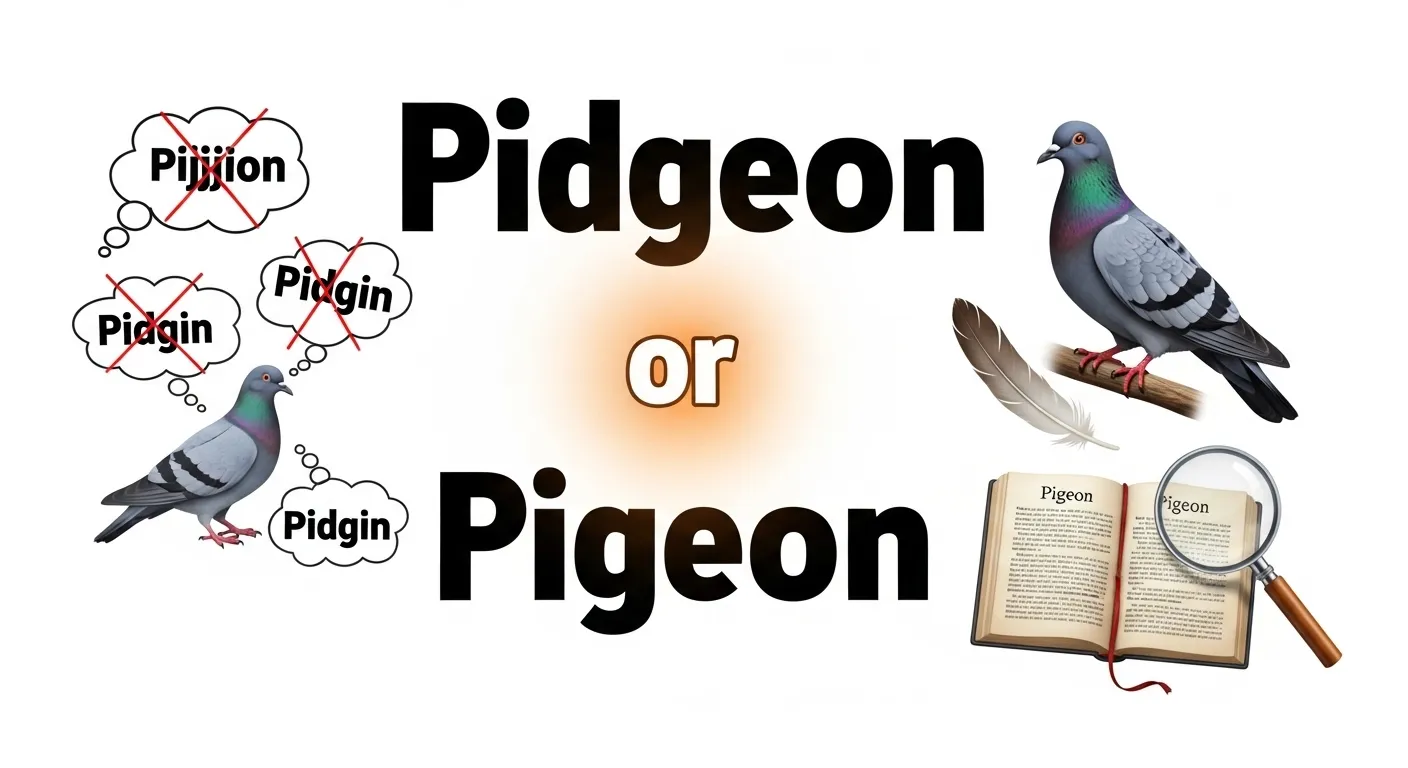
One common confusion is whether to write pidgeon or pigeon.
Writers, students, and nature enthusiasts often wonder which version is correct when describing the familiar birds we see in parks, cities, and countryside alike.
Many people search for pidgeon or pigeon because both spellings appear online, in books, and even in older texts.
The uncertainty mainly arises from phonetic spelling habits and historical variations in English.
Misusing the word can make writing look unprofessional or lead to mistakes in educational contexts.
In this guide, we’ll give you a clear answer, explain the origin of the word, compare British and American spelling rules, and provide practical advice for correct usage.
By the end, you’ll confidently know when to write pigeon instead of pidgeon, and how to avoid common mistakes in everyday writing.
Pidgeon or Pigeon – Quick Answer
- Quick Answer:
- Pigeon → Correct standard spelling in both British and American English
- Pidgeon → Incorrect, commonly seen due to phonetic mistakes
Examples:
- A flock of pigeons gathered at the city square. ✅
- She fed the pidgeons outside her house. ❌
✅ Tip: Always use pigeon. The d is not part of the standard spelling.
The Origin of Pidgeon or Pigeon
The word pigeon comes from the Old French pijon, which referred to young birds or squabs. It was derived from Latin pipio, meaning peeping chick.
Over time, the spelling evolved in English:
- Early English texts sometimes used pidgeon phonetically.
- Modern English standardized it to pigeon.
Historical spelling variations like pidgeon show how English words were often written based on pronunciation before dictionaries standardized spellings.
British English vs American English Spelling
Unlike many words that differ between British and American English, pigeon is the same in both. There is no accepted version with a d in modern usage.
| Feature | British English | American English |
| Standard spelling | pigeon | pigeon |
| Incorrect variant | pidgeon | pidgeon |
| Past usage | Rarely in old texts | Rarely in old texts |
| Example sentence | The city pigeon is common in London. | A pigeon perched on the New York ledge. |
Key Rule: Avoid adding a d. Phonetic mistakes like pidgeon are never correct in modern English.
Which Spelling Should You Use?
- Use pigeon in all contexts:
- UK, Commonwealth countries (Australia, Canada, India, etc.)
- USA and other American English contexts
- Academic writing, news articles, and online content
💡 Tip: There is no scenario where pidgeon is considered correct. Consistency ensures clarity and professionalism.
Common Mistakes with Pidgeon or Pigeon
Even experienced writers sometimes slip. Common mistakes include:
- Wrong letter insertion: I saw a pidgeon on the roof. ❌
- Mixing with slang or regional spelling: Pidgeons are everywhere! ❌
- Plural errors: She fed two pidgeons ❌ → Correct: two pigeons ✅
Quick Fix: Memorize the correct spelling: p-i-g-e-o-n. It works for singular and plural forms (pigeons).
Pidgeon or Pigeon in Everyday Examples
Emails:
- Please check the report on city pigeons in urban areas. ✅
- Our team observed the pidgeons in the park. ❌
News articles:
- Thousands of pigeons flock to Trafalgar Square every day. ✅
Social Media:
- Just fed the pigeons at the local square! ✅
Formal writing:
- The researcher documented the behavior of pigeons in metropolitan areas. ✅
Tip: Always stick with pigeon for credibility and correctness.
Pidgeon or Pigeon – Google Trends & Usage Data
Popularity by country:
- UK, USA, Australia, Canada → pigeon dominates
- Old literature may show occasional pidgeon, but it is largely historical
Context:
- Nature writing: pigeon exclusively used
- Education: Teachers and textbooks always use pigeon
- Online searches: Many type pidgeon by mistake, but Google autocorrects
📊 Pro Tip: If you want to appear authoritative online, optimize your content for pigeon, not pidgeon.
Keyword Variations Comparison
| Variation | Usage | Region |
| pigeon | Correct standard spelling | UK, US, Global |
| pigeons | Plural form | UK, US, Global |
| pidgeon | Incorrect, phonetic mistake | Rare/Old texts |
| pidgeons | Incorrect plural | Rare/Old texts |
FAQs
1. Is pidgeon ever correct?
No. Pidgeon is always incorrect in modern English.
2. Why do some people write pidgeon?
It’s a phonetic spelling based on how the word sounds.
3. Does the pronunciation change between British and American English?
No, both pronounce it the same: /ˈpɪdʒ.ən/.
4. How do you remember the correct spelling?
Think p-i-g-e-o-n—the d is silent and unnecessary.
5. Is there a difference in plural form?
No, simply add s → pigeons.
6. Can pidgeon appear in older texts?
Yes, historically it was used, but it is outdated and incorrect today.
7. Is pigeon used in scientific names?
Yes, e.g., Columba livia refers to the common rock pigeon.
Conclusion
In summary, the only correct spelling is pigeon, while pidgeon is a common phonetic mistake.
Whether you are writing emails, educational materials, news articles, or social media posts, always stick to pigeon to maintain accuracy and professionalism.
Understanding its origin from Old French and Latin helps explain why the spelling does not include a d.
Unlike other words that differ between British and American English, pigeon is uniform worldwide.
Avoid historical or phonetic variations, use the plural correctly as pigeons, and you’ll never have to second-guess your spelling.
Consistency matters. Using pigeon ensures clarity, credibility, and better engagement with your readers, both online and offline.
Read More:
Bearable or Bareable – Which Spelling Is Correct?

I am Samuel Wright, a writer who loves helping people understand English grammar, spelling, and word usage clearly.