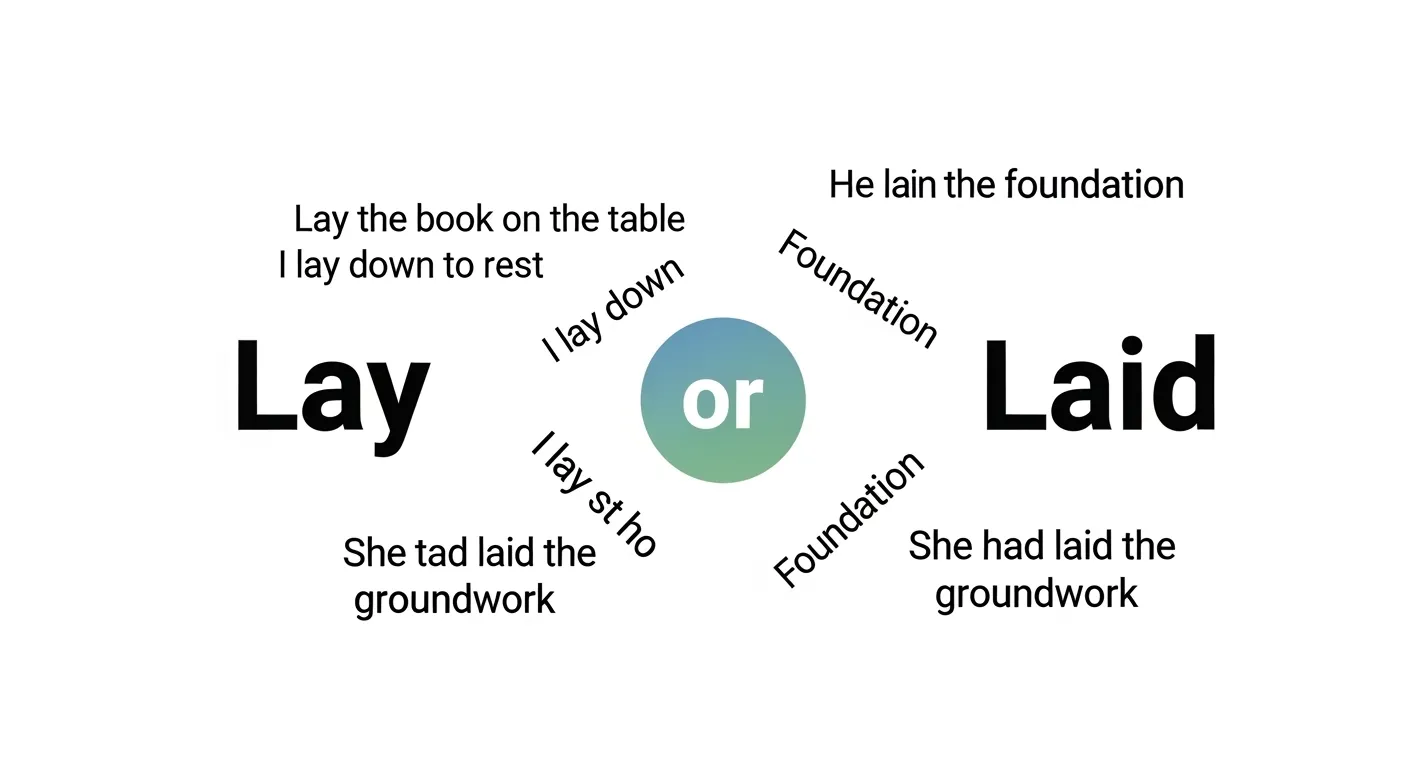
Do you ever pause before writing I will lay the book on the table or I laid the book yesterday?
You’re not alone. Many English learners and even native speakers struggle with lay vs laid.
The confusion comes from the fact that lay and laid look similar, but they serve different purposes in grammar.
Lay is a present tense verb, meaning to put something down.
Laid is the past tense form of lay. Using them incorrectly can make your sentences confusing or sound unprofessional.
For students, bloggers, content writers, and anyone who writes emails or posts online, knowing the difference between lay and laid is essential.
In this article, we will explain the quick rules, the origin of the words, how British and American English differ, common mistakes, real-life examples, and even Google trends to see which form is most popular.
By the end, you’ll be confident using lay and laid correctly in writing and conversation.
Lay vs Laid – Quick Answer
Lay → Present tense; means to put or place something down.
Laid → Past tense of lay; means you already put something down.
Examples:
- I lay the keys on the table every morning.
- Yesterday, I laid the keys on the table.
The Origin of Lay or Laid
The verbs lay and laid come from Old English lecgan, meaning to place or put down. Over centuries, English developed irregular verb forms, which is why we now say:
- Present: lay
- Past: laid
- Past participle: laid
Knowing this origin helps you understand why these verbs look similar but follow specific grammar rules.
British English vs American English Spelling
Both British and American English use the same forms for lay and laid. The difference lies mainly in other verb forms like learnt vs learned. For lay/laid, the spelling is consistent:
| Form | British English | American English |
| Present | lay | lay |
| Past | laid | laid |
| Past Participle | laid | laid |
So, whether you’re in London or New York, lay and laid are spelled the same.
Which Spelling Should You Use?
- US English: Use lay for present, laid for past.
- UK/Commonwealth: Same rules as US English.
- Global Audience: Stick to standard grammar; using lay and laid correctly avoids confusion in emails, articles, and posts.
Common Mistakes with Laid or Lay
- Incorrect: I laid the book on the table now.
Correct: I lay the book on the table now. - Incorrect: Yesterday, I lay the keys on the desk.
Correct: Yesterday, I laid the keys on the desk. - Confusing lie (to recline) with lay (to place).
- Lie example: I lie down every afternoon.
- Lay example: I lay the towel on the chair.
Lay or Laid in Everyday Examples
Emails:
- Please lay the documents on my desk by 3 PM.
- I laid the files in the cabinet yesterday.
News Headlines:
- Workers laid off due to company restructuring. (different meaning: lay off)
Social Media:
- Just laid the new album on my playlist!
Formal Writing:
- The professor laid out the syllabus clearly for all students.
Lay or Laid – Google Trends & Usage Data
According to Google Trends, laid shows higher search interest during learning months (back-to-school season) in English-speaking countries.
- US: High searches for lay or laid meaning
- UK: Slightly higher interest in grammar articles for exams
- Global: SEO content often focuses on correct usage in emails and blogs
Comparison Table: Lay vs Laid
| Verb Form | Present | Past | Past Participle | Example Sentence |
| Lay | lay | laid | laid | I lay the book on the table. |
| Laid | — | laid | laid | I laid the book on the table. |
FAQs
1. Is lay the same as lie?
No. Lay means to put something down. Lie means to recline.
2. Can I say I have lay the book?
Incorrect. The correct form is I have laid the book.
3. What is the past tense of lay?
The past tense is laid.
4. Can laid be used in informal speech?
Yes, but only as the past tense of lay.
5. Is lay down correct?
Yes, but lay down can mean physically placing something or figuratively resigning.
6. How to remember the difference between lay and lie?
Remember: Lay = put something down, Lie = recline by yourself.
7. Can I use laid in emails?
Yes, it’s perfect for past actions, e.g., I laid the files on your desk.
Conclusion
Mastering lay and laid is easier than it seems. Remember: lay is present tense, and laid is past tense.
Confusing them can change the meaning of your sentence, especially in writing or professional communication.
Using these words correctly improves your emails, blog posts, social media updates, and even academic writing.
With practice, you’ll be able to choose the right form instantly.
Pay attention to common mistakes, and refer to tables or real-life examples when in doubt.
Over time, using lay and laid correctly will make your writing sound confident and professional.
Whether you’re in the US, UK, or writing for a global audience, following these rules ensures clarity.
Keep practicing in daily conversations, emails, and essays. Soon, lay or laid will no longer be a problem it will be second nature.
Read More:
Elliptical or Treadmill – Which One Is Better for Your Workout?

Hi, I’m Ethan Hawkesley. I love writing and exploring the English language. On Thinkoora.com, I share tips, insights, and explanations to help readers understand words and writing more easily.