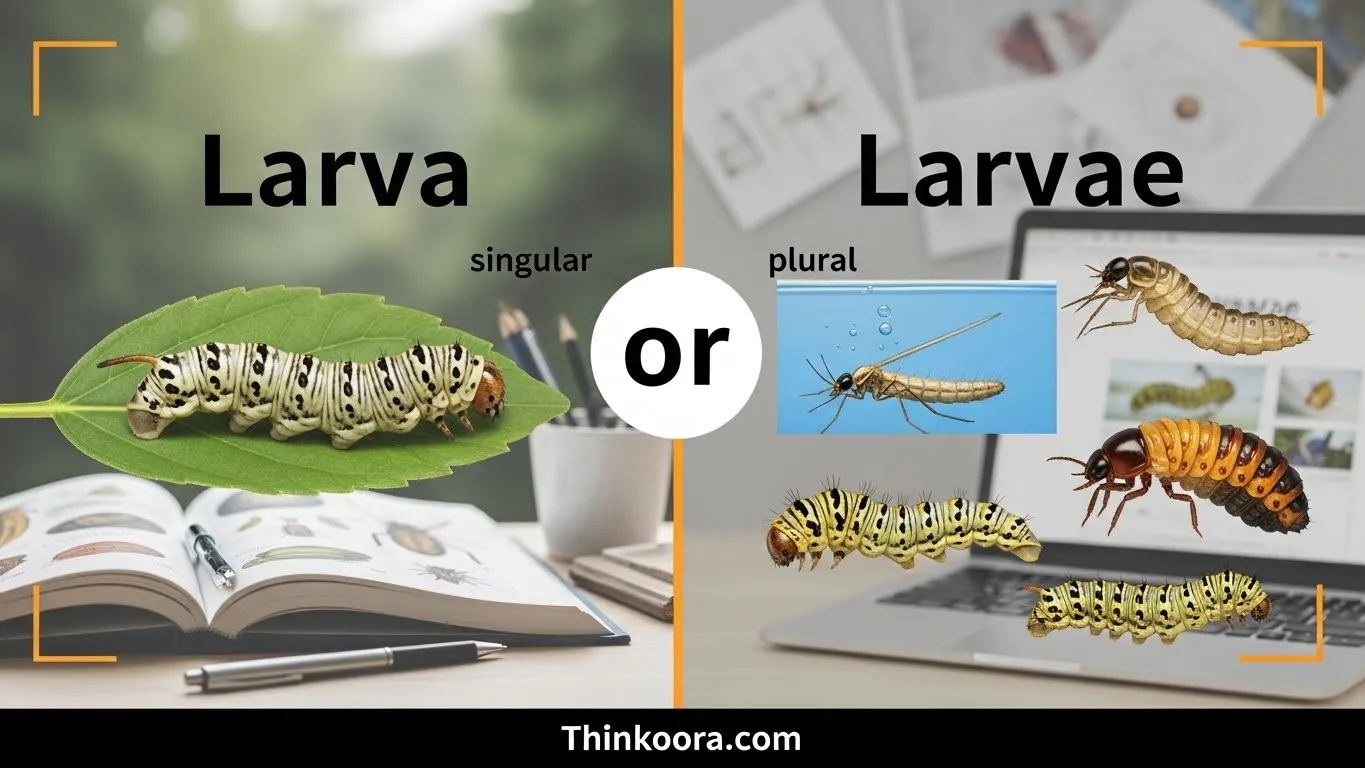
Many writers hesitate when choosing between larva and larvae.
Is larva singular? Is larvae plural? This confusion is common because these scientific words do not follow normal English plural rules.
People search for larva or larvae to get a clear answer.
This guide explains the difference simply, with real examples and practical tips, so you can use larva and larvae correctly and with confidence every time.
Larva or Larvae – Quick Answer
The difference between larva and larvae is number.
- Larva → singular (one)
- Larvae → plural (more than one)
Examples
- A butterfly starts life as a larva.
- Many insects begin as larvae.
They mean the same thing, but larva refers to one, and larvae refers to many.
The Origin of Larva or Larvae
The words larva and larvae come from Latin, not modern English. In Latin:
- Larva meant a mask, ghost, or hidden form.
- Scientists later used the word to describe an immature insect that looks very different from its adult form.
In Latin grammar:
- -a endings are often singular.
- -ae endings are plural.
English kept these forms when adopting scientific terms. That is why we say larva/larvae instead of larva/larvas. Many biology terms follow this same rule, such as:
- alga / algae
- antenna / antennae
The spelling difference exists because English borrowed the word without changing its original plural form.
British English vs American English Spelling
Unlike many spelling pairs, larva and larvae do not change between British and American English.
Key Point
- Both UK and US English use:
- larva (singular)
- larvae (plural)
There is no spelling variation, only a singular vs plural difference.
Comparison Table
| Aspect | British English | American English |
| Singular | larva | larva |
| Plural | larvae | larvae |
| Meaning | Same | Same |
| Scientific usage | Identical | Identical |
This makes usage simpler than many other English word pairs.
Which Spelling Should You Use?
Your choice depends on how many you are talking about, not your audience.
Use larva if:
- You are talking about one insect
- The noun is singular
Example:
A mosquito larva lives in water.
Use larvae if:
- You are talking about two or more
- The noun is plural
Example:
Mosquito larvae live in stagnant water.
Global Writing Tip
No matter where your audience is US, UK, or global the rule stays the same. Just match the word to the number.
Common Mistakes with Larva or Larvae
These mistakes appear often in writing and exams.
Using larva as a plural ❌
- Many larva were found in the pond.
✔ Many larvae were found in the pond.
Adding s to larvae ❌
- The larvae’s were studied.
✔ The larvae were studied.
Mixing singular and plural verbs ❌
- The larvae is growing.
✔ The larvae are growing.
❌ Avoiding the word due to fear
Some writers avoid both forms. Learning the rule is easier than avoiding the word.
Larva or Larvae in Everyday Examples
Emails
- We found a larva in the sample.
- Several larvae appeared after the rain.
News Writing
- Health officials detected mosquito larvae in standing water.
- A rare beetle larva was discovered by researchers.
Social Media
- Found a weird larva in my garden today!
- These larvae will soon turn into butterflies 🦋
Formal Writing
- The larva undergoes several stages of growth.
- The larvae were observed under laboratory conditions.
Larva or Larvae – Google Trends & Usage Data
Search data shows that larva or larvae is commonly searched by:
- Students
- Biology learners
- ESL writers
- Science bloggers
Usage by Context
- Education & exams: high usage of both terms
- Scientific writing: larvae appears more often
- Everyday writing: larva searched more often
By Country
- United States: high academic searches
- United Kingdom: similar trend
- Global: consistent use due to scientific relevance
Most searches are clarification-based, showing people want a simple explanation of singular vs plural.
Larva vs Larvae Comparison Table
| Word | Number | Meaning | Correct |
| larva | Singular | One immature insect | ✅ |
| larvae | Plural | More than one | ✅ |
| larvas | Incorrect | Nonstandard plural | ❌ |
Frequently Asked Questions (FAQs)
1. Is larvae singular or plural?
Larvae is plural.
2. Is larva plural?
No. Larva is singular.
3. Can I say larvas?
No. The correct plural form is larvae.
4. Do British and American English differ here?
No. Both use the same forms.
5. Why doesn’t larvae end with s?
Because it comes from Latin, not English.
6. Is larvae formal English?
Yes. It is standard in both scientific and general writing.
7. What is the easiest way to remember?
Think: A → one, AE → many.
Conclusion
The difference between larva or larvae is simple once you understand it.
Larva refers to one immature insect, while larvae refers to more than one.
There is no American vs British spelling debate here both forms are used worldwide in the same way.
The confusion exists because these words come from Latin and follow Latin plural rules.
This makes them look unusual compared to regular English nouns. Still, the rule is clear and consistent.
If you focus on number, you will always choose the correct form.
Use larva for one and larvae for many. This small detail can greatly improve clarity in academic, professional, and everyday writing.
Once learned, this rule becomes second nature and you’ll never second-guess larva or larvae again.
Read More:
Proper or Propper: Which Spelling Is Correct and When to Use It

I am Samuel Wright, a writer who loves helping people understand English grammar, spelling, and word usage clearly.