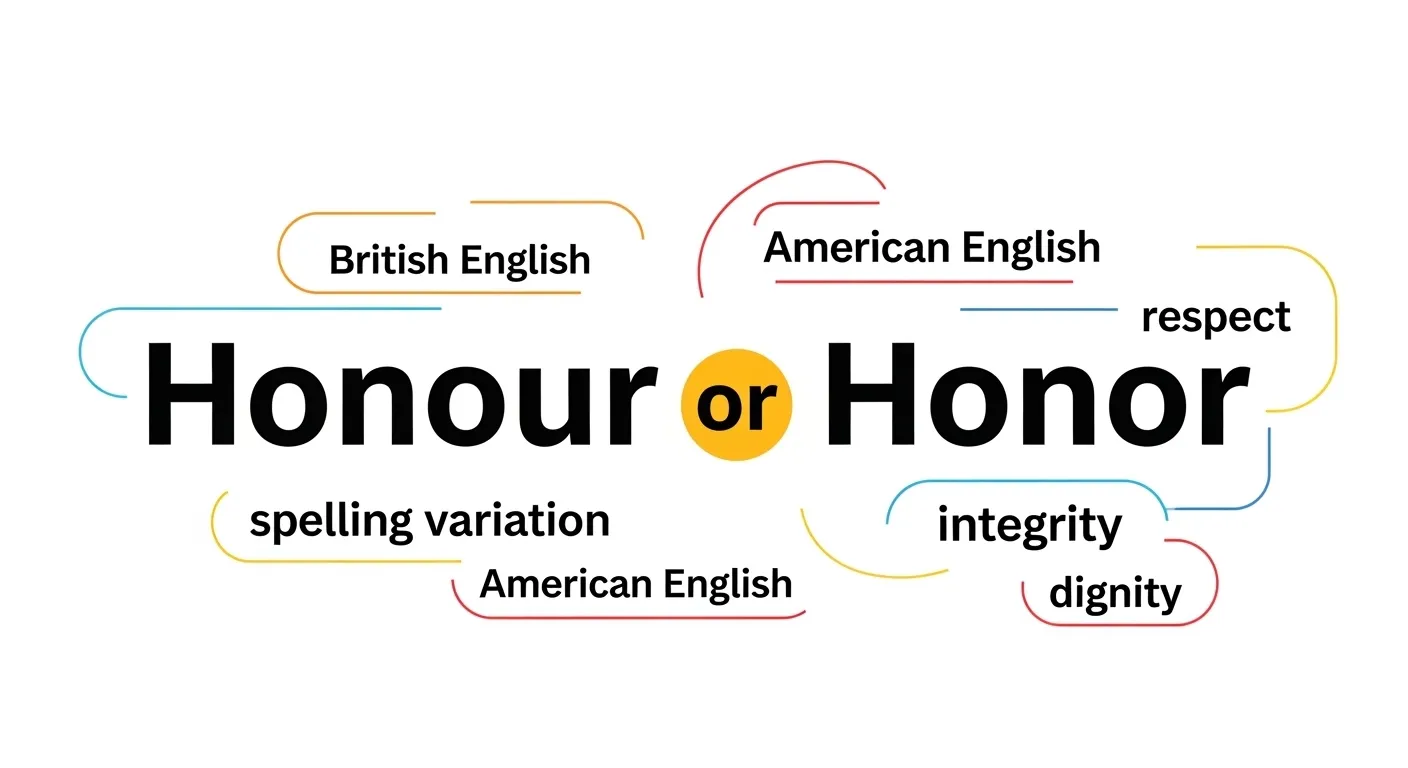
Do you ever pause and wonder whether it’s honour or honor ?
This small spelling difference often confuses writers, students, and professionals worldwide.
The answer depends largely on where you are and who your audience is.
In today’s globalized world, understanding the subtle differences between British and American English can save embarrassment and make your writing appear polished and professional.
People search for Honour or Honor because they want clarity.
Whether it’s for essays, emails, official documents, or social media posts, choosing the correct spelling matters.
Misusing it can subtly undermine your credibility, especially in formal or academic writing.
This article not only provides a quick answer but also explores the history, usage, common mistakes, and practical examples.
By the end, you’ll confidently know which spelling to use, why it matters, and how to apply it correctly in everyday writing.
Honour or Honor – Quick Answer
- Quick answer:
- Honour → British English, used in the UK, Canada, Australia, and other Commonwealth countries.
- Honor → American English, used in the USA.
Examples:
- British English: She received a medal of honour for her bravery.
- American English: He was awarded the honor for his contribution to science.
✅ Remember: The meaning is identical; only the spelling changes.
The Origin of Honour or Honor
The word honour/honor comes from the Latin honor, meaning esteem or respect.
- Middle English: Honour was adopted around the 13th century, influenced by Old French honur.
- American simplification: Noah Webster, the 19th-century American lexicographer, advocated simpler spellings, leading to the drop of u in words like colour/color, labour/labor, and honour/honor.
This explains why the UK retains the u, while the US prefers the simplified form.
British English vs American English Spelling
The difference is straightforward:
| Word | British English | American English |
| Honour | ✔ honour | ❌ honor |
| Colour | ✔ colour | ❌ color |
| Labour | ✔ labour | ❌ labor |
| Favourite | ✔ favourite | ❌ favorite |
| Neighbour | ✔ neighbour | ❌ neighbor |
Rule of thumb:
- British English often keeps the u in words ending with -our.
- American English drops the u , forming -or endings.
Which Spelling Should You Use?
- US audience: Use honor.
- UK/Commonwealth audience: Use honour.
- Global content: Choose based on your primary readership. Consistency matters more than regional correctness.
Tip: In professional writing, pick one style and stick with it throughout the document.
Common Mistakes with Honour or Honor
Many writers misuse honour/honor because:
- Mixing UK and US spellings in the same text.
- Using honor in UK-based documents (e.g., official letters).
- Assuming the spelling changes the meaning.
Corrections:
- ❌ Incorrect: She showed great honor in completing her tasks. (UK)
- ✅ Correct: She showed great honour in completing her tasks. (UK)
- ❌ Incorrect: The committee gave him honour. (US)
- ✅ Correct: The committee gave him honor. (US)
Quick tip: Spellings are audience-specific, not meaning-specific.
Honour or Honor in Everyday Examples
Emails:
- UK: It would be an honour to collaborate with you.
- US: It would be an honor to work with you.
News articles:
- UK: The soldier received the Victoria Cross, the highest honour.
- US: The firefighter received the Medal of Honor for bravery.
Social media:
- Feeling proud and honoured to receive this recognition! (UK)
- Feeling proud and honored to receive this recognition! (US)
Formal writing:
- Always maintain consistency; don’t mix spellings.
Honour or Honor – Google Trends & Usage Data
According to Google Trends:
- Honour dominates searches in the UK, Canada, Australia, and India.
- Honor dominates in the USA.
- Globally, honor is more searched due to the larger American audience online.
Insight: Use the spelling that aligns with your target audience, especially in SEO and professional content.
Keyword Variations Side by Side
| Variation | Region | Example Sentence |
| Honour | UK, Canada, AU | She was awarded the Order of Honour. |
| Honor | USA | He received the Medal of Honor for his service. |
| Honouring/Honoring | UK / US | They are honouring their veterans today. / They are honoring their veterans today. |
FAQs about Honour or Honor
1. Is honour and honor the same word?
Yes, they are the same word with identical meaning; only the spelling differs by region.
2. Should I use honour or honor in academic writing?
Use the spelling consistent with your institution’s style guide (UK vs US English).
3. Can I mix honour and honor in the same text?
No. Mixing spellings looks unprofessional. Stick to one style.
4. Does dropping the u change the meaning?
No, meaning remains the same. Only spelling changes.
5. Is honour used in American English at all?
Rarely. It appears in historical texts or British-influenced contexts.
6. What about online content?
SEO-wise, use the spelling your target audience searches for. For US readers, use honor.
7. How do you pronounce honour vs honor?
Both are pronounced the same: /ˈɒn.ər/ in UK, /ˈɑː.nɚ/ in US.
Conclusion
The spelling of honour or honor is a simple yet important choice in writing. Remember:
- Honour → UK/Commonwealth spelling, keep the u .
- Honor → American English, drop the u .
- Consistency matters more than region; choose a style and stick with it.
- Understanding your audience, context, and platform ensures your writing looks professional.
Whether writing an email, article, or formal report, using the correct spelling can make a subtle but strong impression.
For global content, if your audience spans multiple regions, consider audience-based adjustments or footnotes if appropriate.
Finally, staying aware of these differences helps you avoid common mistakes, improve readability, and maintain credibility in any English-speaking setting.
Read More:
Inquiries or Enquiries: Which One Should You Use?
The or Whale: Key Differences Explained

Hi, I’m Ethan Hawkesley. I love writing and exploring the English language. On Thinkoora.com, I share tips, insights, and explanations to help readers understand words and writing more easily.