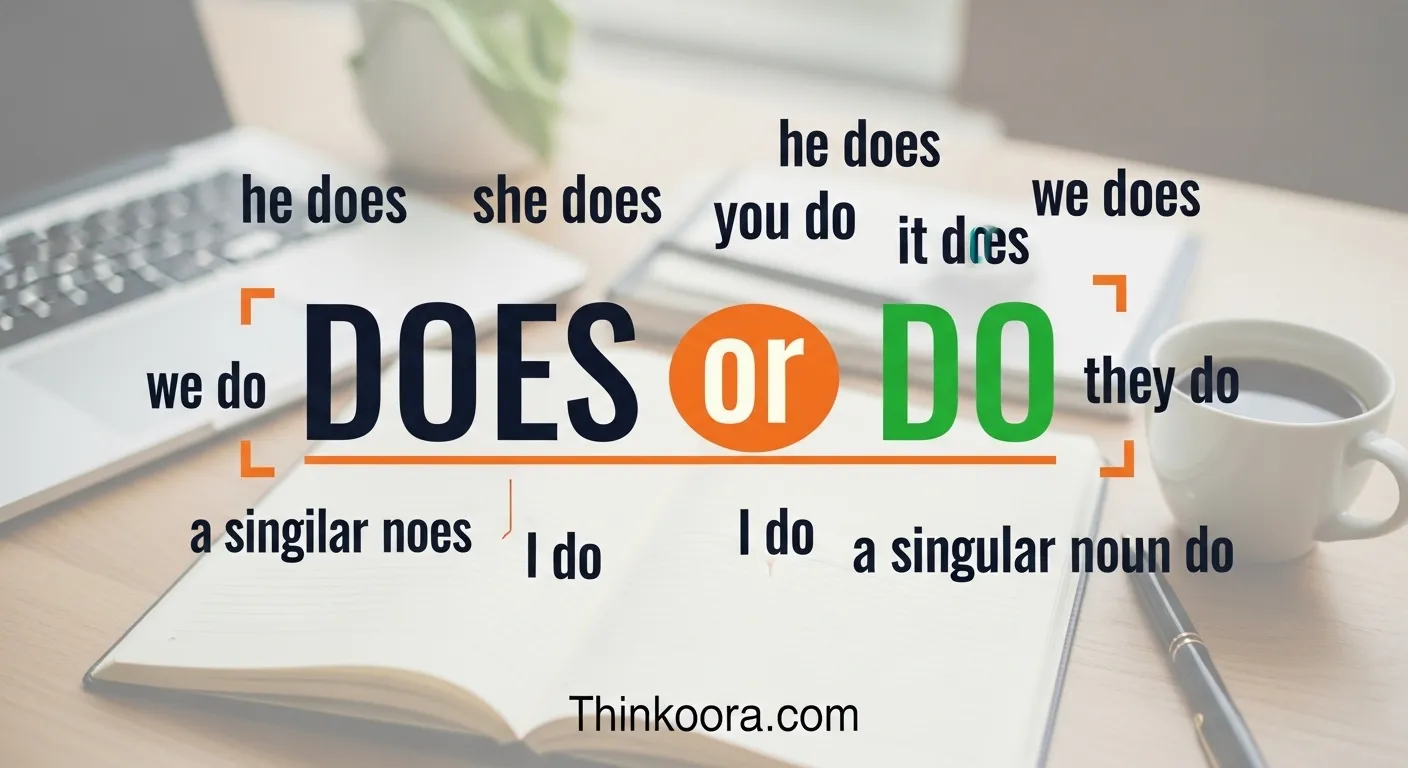
Imagine writing an email to your boss. You type: She does the report every Monday. Something feels wrong. You pause and wonder: should it be do or does?
Many English learners face this exact problem.
The words does and do are common verbs in English. Yet they cause confusion in grammar, writing, and conversation.
People often search does or do online because they are unsure which form fits the sentence.
The confusion happens because English verbs change depending on the subject. For example, I, you, and they use do, while he, she, and it use does.
Small grammar rules like this can affect how natural your English sounds.
Understanding does or do helps improve everyday communication. It makes emails clearer, conversations smoother, and writing more professional.
In this guide, you will learn the quick answer, the history of the words, usage rules, common mistakes, and real-life examples so you can use does or do with confidence.
Does or Do – Quick Answer
The difference between does and do depends on the subject of the sentence.
- Do is used with I, you, we, and they.
- Does is used with he, she, and it.
Simple Examples
- I do my homework every day.
- You do a great job.
- They do their work on time.
- He does his homework every day.
- She does the cleaning.
- It does the job well.
Question Examples
Both forms also help create questions.
- Do you like coffee?
- Do they live here?
- Does she work here?
- Does he know the answer?
In short:
- Do → plural or first/second person
- Does → singular third person
The Origin of Does or Do
The verb do has a long history in English. It comes from the Old English word dōn. This word meant to perform, act, or make something happen.
In early English, verbs changed form depending on the subject. Over time, the language kept the form does for the third-person singular.
Historical Development
- Old English: dōn (to perform or act)
- Middle English: do / dooth
- Modern English: do / does / did
The form does developed to match grammar rules where verbs change with he, she, or it.
For example:
- He does the work.
- She does the task.
This pattern still exists today in modern English grammar.
British English vs American English Spelling
Unlike many English words, does or do do not change spelling between British English and American English. Both regions use the same forms.
However, usage patterns can differ slightly in style and tone.
For example:
- British English sometimes uses more formal sentence structures.
- American English may prefer shorter and direct sentences.
Example Sentences
British English
- She does the shopping every Saturday.
- Do you fancy some tea?
American English
- She does the grocery shopping every Saturday.
- Do you want some coffee?
Comparison Table
| Grammar Feature | British English | American English |
| Base verb | do | do |
| Third-person singular | does | does |
| Past tense | did | did |
| Question form | Do you work here? | Do you work here? |
As you can see, does or do remain identical in both versions of English.
Which Spelling Should You Use?
Choosing between does or do depends on grammar, not geography.
Follow this simple rule:
Use Do with:
- I
- You
- We
- They
Examples:
- I do my work early.
- They do their homework together.
Use Does with:
- He
- She
- It
Examples:
- He does his homework daily.
- She does the report every Friday.
Quick Guide by Audience
| Audience | Preferred Usage |
| US English | Standard grammar rules |
| UK English | Same grammar rules |
| Global English | Follow subject-verb agreement |
No matter where you write English, grammar rules remain the same.
Common Mistakes with Does or Do
Many learners mix up does or do because they focus on the verb instead of the subject.
Here are the most common errors.
Mistake 1: Using do with singular subjects
❌ He do the work.
✅ He does the work.
Mistake 2: Using does with plural subjects
❌ They does their homework.
✅ They do their homework.
Mistake 3: Using does with I
❌ I does my job.
✅ I do my job.
Mistake 4: Incorrect question form
❌ Does you like tea?
✅ Do you like tea?
Simple Tip
If the subject is he, she, or it, use does.
Otherwise, use do.
Does or Do in Everyday Examples
Understanding does or do becomes easier when you see real-life examples.
Emails
- Do you have time for a meeting tomorrow?
- She does the weekly report.
News Headlines
- The company does well in global markets.
- Experts do research on climate change.
Social Media
- Why do people love this movie?
- He does amazing artwork.
Formal Writing
- The organization does important work worldwide.
- Researchers do several experiments each year.
These examples show how common does or do are in everyday English.
Does or Do – Google Trends & Usage Data
Search data shows that does or do is a frequent grammar query. Many people search it when learning English.
Popular Countries Searching This Query
- India
- Pakistan
- United States
- Philippines
- United Kingdom
These regions have large numbers of English learners.
Why People Search This Keyword
Common search queries include:
- does or do grammar
- when to use does or do
- does or do in questions
- does or do examples
Most searches come from students, writers, and professionals improving their English.
Comparison Table: Does vs Do
| Feature | Do | Does |
| Subject type | Plural / I / You | Third-person singular |
| Example subject | I, you, we, they | he, she, it |
| Example sentence | They do the work | She does the work |
| Question example | Do you understand? | Does he understand? |
| Grammar category | Base verb | Third-person singular verb |
This table provides a quick visual guide to the difference between does or do.
FAQs
1. What is the difference between does or do?
The difference depends on the subject.
Use do with I, you, we, and they.
Use does with he, she, and it.
2. When should I use does in a sentence?
Use does when the subject is third-person singular.
Example:
- She does her homework every day.
3. Can does be used in questions?
Yes. It often starts questions with he, she, or it.
Example:
- Does he live here?
4. Is do used for plural subjects?
Yes. Do works with plural subjects.
Example:
- They do their work together.
5. Do British and American English use different forms?
No. Both use do and does in the same way.
6. Why do learners confuse does or do?
The confusion happens because English verbs change based on subject agreement.
7. Can do and does act as helper verbs?
Yes. They help form questions, negatives, and emphasis.
Example:
- Do you understand?
- She does like chocolate.
Conclusion
The difference between does or do is simple once you understand subject-verb agreement. The verb do works with I, you, we, and they, while does is used with he, she, and it.
These words may seem small, but they are essential in English grammar. They appear in questions, statements, and everyday conversations.
Using them correctly helps your writing sound clear, professional, and natural.
Remember this easy rule:
If the subject is third-person singular, use does. Otherwise, use do.
Also, keep in mind that British and American English follow the same grammar rule, so you do not need to change the spelling depending on location.
By practicing real examples such as emails, social media posts, and conversations you can quickly master does or do. Over time, the correct form will feel natural.
When in doubt, check the subject of the sentence first. That simple step will help you choose the correct verb every time.
Read More:
Archeologist or Archaeologist: Which Spelling Is Correct?
Knives or Knifes: Which Spelling Is Correct?

I’m Daniel Whitmore, a content writer who focuses on English grammar, spelling mistakes, and word usage. I write clear, simple, and helpful articles to make English easier for students, writers, and everyday readers.