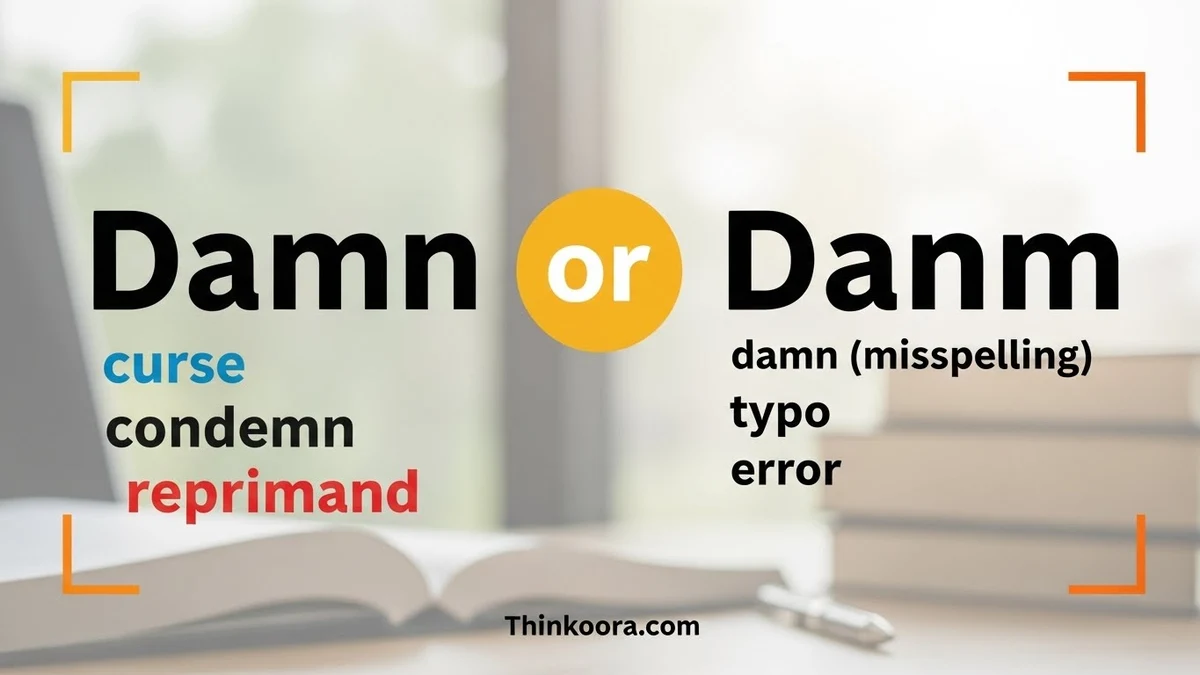
Many people search for damn or danm because they are unsure about the correct spelling of this commonly used exclamation.
Whether in casual conversation, text messages, or writing, confusion often arises due to typographical errors or phonetic spelling. Knowing the right form is essential for clear and professional communication.
The word damn has multiple uses it can express frustration, emphasis, or mild anger, and it can also appear in literary or rhetorical contexts.
Using the incorrect spelling, such as danm, can make your writing appear careless or confusing.
This article provides a thorough explanation of the correct spelling, its origins, regional usage, examples, common mistakes, and practical advice, helping you confidently write and communicate without error.
Damn or Danm – Quick Answer
- ✅ Damn is the correct spelling.
- ❌ Danm is incorrect and considered a typographical error.
Examples:
- Correct: I damn well finished my work on time.
- Incorrect: I danm well finished my work on time.
Tip: Always use damn in formal and informal writing, while avoiding danm, which is never recognized in dictionaries or formal style guides.
The Origin of Damn
- The word damn comes from the Latin damnare, meaning to condemn or to sentence.
- Historically, it was used in religious or legal contexts, referring to condemning someone to hell or eternal punishment.
- Over time, it became an exclamation for frustration, emphasis, or mild swearing in everyday language.
British English vs American English Spelling
| Word | British English | American English | Notes |
| Damn | ✅ Correct | ✅ Correct | Standard spelling in all English variants |
| Danm | ❌ Incorrect | ❌ Incorrect | Typographical error, never accepted |
Key Insight:
Unlike words with regional spelling variations, damn is universally correct across all English-speaking regions. Avoid danm entirely.
Which Spelling Should You Use?
- Always use damn in all contexts, whether you are writing in British English, American English, Canadian English, or Australian English.
- Example for emphasis: I damn well told you the truth.
- Example in literature: The villain was damned for his actions.
Rule of Thumb: Ignore danm as it is a typo or informal misspelling.
Common Mistakes with Damn
- ❌ Writing danm instead of damn.
✅ Correct: This is damn good pizza. - ❌ Confusing damn with dam (barrier holding water).
✅ Correct: The dam is holding back the river.
✅ Correct: I damn well finished my work. - ❌ Using damn excessively in formal writing.
✅ Solution: Limit usage or replace with very, extremely, or challenging in professional contexts.
Damn or Danm in Everyday Examples
Emails
- Casual: That was a damn good presentation.
- Formal: That was an extremely effective presentation. (Avoid damn in formal emails)
News Articles
- Example: The team gave a damn good performance in the finals.
- Avoid danm, as it will look like a typo.
Social Media
- Example: I can’t believe this damn thing happened again!
- Incorrect: I can’t believe this danm thing happened again!
Literature & Creative Writing
- Example: He was damned if he tried to escape.
- Danm is never acceptable in any literary work.
Damn – Google Trends & Usage Data
- Searches for damn are consistent worldwide in English-speaking countries.
- Spelling errors like danm are relatively rare and often corrected automatically by search engines.
- The word is more popular in informal contexts like social media, entertainment, and blogs than in academic writing.
Comparison Table: Damn vs Danm
| Feature | Damn | Danm |
| Spelling | ✅ Correct | ❌ Incorrect |
| Meaning | Expresses emphasis, frustration, or condemnation | No meaning; typo only |
| Audience | All English speakers | N/A |
| Usage Context | Informal, literary, creative writing | Typo, incorrect |
| Common Errors | Overuse in formal writing | Misspelling in text or online |
| Example | This is damn amazing! | This is danm amazing! ❌ |
FAQs About Damn or Danm
- Is danm ever correct?
❌ No, it is always a typo or misspelling. - Can damn be used in formal writing?
⚠️ Rarely. Use alternatives like very, extremely, or challenging for professionalism. - Is damn offensive?
✅ Mildly. It is considered a soft curse word in casual speech. Avoid in sensitive or professional settings. - What is the past tense of damn?
✅ Damned. Example: He was damned for his mistakes. - Can damn replace very for emphasis?
✅ Yes, in casual writing. Example: That’s a damn good cake. - Is damn used worldwide?
✅ Yes, recognized in all English-speaking regions. - How can I avoid spelling mistakes?
✅ Use spellcheck tools and be aware that danm is always wrong.
Conclusion
The correct spelling is always damn, while danm is an incorrect typographical error. Damn has historical and linguistic roots in Latin, evolving to modern usage as an exclamation of frustration, emphasis, or mild swearing.
The word is universally recognized in all English-speaking regions, including the UK, US, Canada, and Australia.
To write professionally and clearly:
- Avoid danm entirely.
- Limit damn in formal writing.
- Maintain consistency and consider audience and context.
By following these guidelines, you can communicate effectively, write accurately, and avoid embarrassing spelling mistakes.
Read More:
Buffaloes or Buffalos? Simple Rules and Examples
Nap or Knap: Spelling, Meaning, and Tips (2026)
British vs English: What’s the Difference?
Cheff or Chef: Common Spelling Mistake Explained

Hi, I’m Ethan Hawkesley. I love writing and exploring the English language. On Thinkoora.com, I share tips, insights, and explanations to help readers understand words and writing more easily.