Have you ever paused while writing an email, article, or report and wondered, Should I write companies or company’s?
This confusion is more common than you think.
Many English writers struggle with knowing when to use the plural form versus the possessive form of the word company.
Using the wrong form can make your writing appear unprofessional or unclear.
People search for this keyword because they want quick guidance on proper grammar.
It often comes up in business communications, academic writing, social media posts, and even casual conversations.
Understanding the difference not only improves your writing but also ensures that your meaning is accurately conveyed.
In this article, we’ll break down the rules, provide examples, and show you which spelling works best in different contexts.
By the end, you’ll confidently know when to use companies and when to use company’s.
Companies or Company’s – Quick Answer
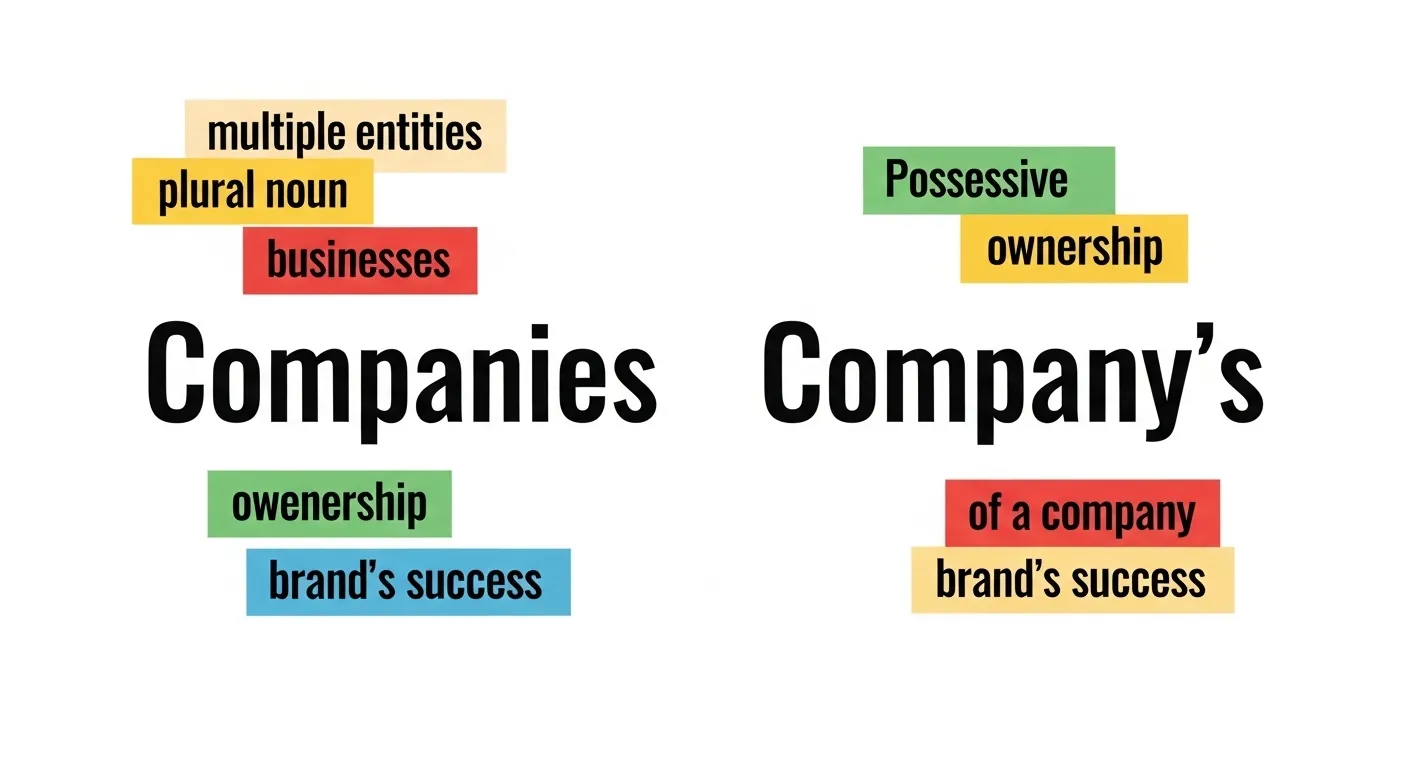
- Companies → This is the plural form of company. Use it when referring to more than one company.
Example: Many companies are investing in renewable energy. - Company’s → This is the possessive form of company. Use it when showing that something belongs to a single company.
Example: The company’s profits increased this year.
Quick Tip:
- Plural → s → multiple entities.
- Possessive → ’s → ownership or belonging.
The Origin of Companies or Company’s
The word company comes from the Latin companio, meaning one who eats bread with another — essentially, a companion or group. Over time, it evolved to refer to a business organization.
- Plural form: English simply adds -s to make most nouns plural: company → companies.
- Possessive form: English uses ’s to indicate possession: company → company’s.
The distinction has remained clear in modern English, but learners often confuse plural forms with possessive forms because they sound similar when spoken.
British English vs American English Spelling
Both British and American English follow the same rules for plural and possessive forms of company, so there is no spelling difference in this case. However, context and punctuation are key.
| Form | British English Example | American English Example |
| Companies | Several companies attended the fair. | Several companies attended the fair. |
| Company’s | The company’s policy is strict. | The company’s policy is strict. |
Note: Other words sometimes vary between UK and US spelling, but company remains the same.
Which Spelling Should You Use?
- US audience → Use standard plural and possessive forms: companies and company’s.
- UK/Commonwealth audience → Same usage rules apply. Focus on context.
- Global writing → When unsure, follow the contextual meaning: plural vs possessive.
Rule of Thumb: Think: Do I mean multiple companies, or do I mean something belongs to a company?
Common Mistakes with Companies or Company’s
Many writers mix these forms. Here are frequent errors:
- ❌ The companies’s policy is clear. → Wrong.
- ✅ The company’s policy is clear. → Correct.
- ❌ Company’s are growing fast. → Wrong.
- ✅ Companies are growing fast. → Correct.
- ❌ I spoke with the companies’ CEO about the issue. → Wrong if referring to one company.
- ✅ I spoke with the company’s CEO about the issue. → Correct for singular.
Tip: Double-check if you are talking about ownership (’s) or quantity (s).
Companies or Company’s in Everyday Examples
Emails
- The company’s meeting will start at 10 AM.
- Several companies attended the conference.
News Articles
- The company’s new policy aims to reduce carbon emissions.
- Many tech companies are shifting to remote work.
Social Media
- Our company’s team is growing! #TeamGrowth
- Top companies hiring in 2026 revealed.
Formal Writing
- The company’s financial statements were audited.
- Companies worldwide face supply chain challenges.
Companies or Company’s – Google Trends & Usage Data
According to Google Trends:
- Companies peaks during economic reports, business news, and stock market updates.
- Company’s spikes when referring to annual reports, policies, or corporate announcements.
Popular countries searching this term:
- United States
- United Kingdom
- India
- Canada
- Australia
This shows that both forms are relevant globally, but plural form searches are slightly higher, likely due to multiple-company news coverage.
Comparison Table: Companies vs Company’s
| Feature | Companies | Company’s |
| Form | Plural | Singular possessive |
| Meaning | More than one company | Belongs to a single company |
| Example | Many companies invest in tech. | The company’s revenue increased. |
| Audience Use | US, UK, Global | US, UK, Global |
| Common Mistake | Using with apostrophe | Using as plural without context |
FAQs
- Can I use company’s for plural ownership?
No. For multiple companies, use companies’. - Is companies or company’s more common?
Both are common; companies appears more in business news. - How do I remember the difference?
Plural → s → more than one.
Possessive → ’s → shows ownership. - Can I write companies’s?
❌ Incorrect. Use companies’ if referring to possession by multiple companies. - Does British English use a different rule?
No, rules are the same for plural and possessive. - Is it okay to say the companys profit?
❌ Incorrect. Always use company’s profit. - When should I use an apostrophe?
Only to show possession: company’s logo, companies’ assets.
Conclusion
Understanding the difference between companies and company’s is essential for clear and professional writing. Remember:
- Companies → plural, more than one company.
- Company’s → singular possessive, something belongs to one company.
- Double-check context: ownership or quantity.
- Usage is consistent across British and American English, so focus on meaning.
By following these simple rules, you’ll avoid common grammar mistakes, write confidently, and convey your message accurately.
Whether in emails, reports, news, or social media, using the correct form demonstrates professionalism and attention to detail.
Read More:
Cancelling or Canceling – Which Spelling is Correct?

I am Samuel Wright, a writer who loves helping people understand English grammar, spelling, and word usage clearly.