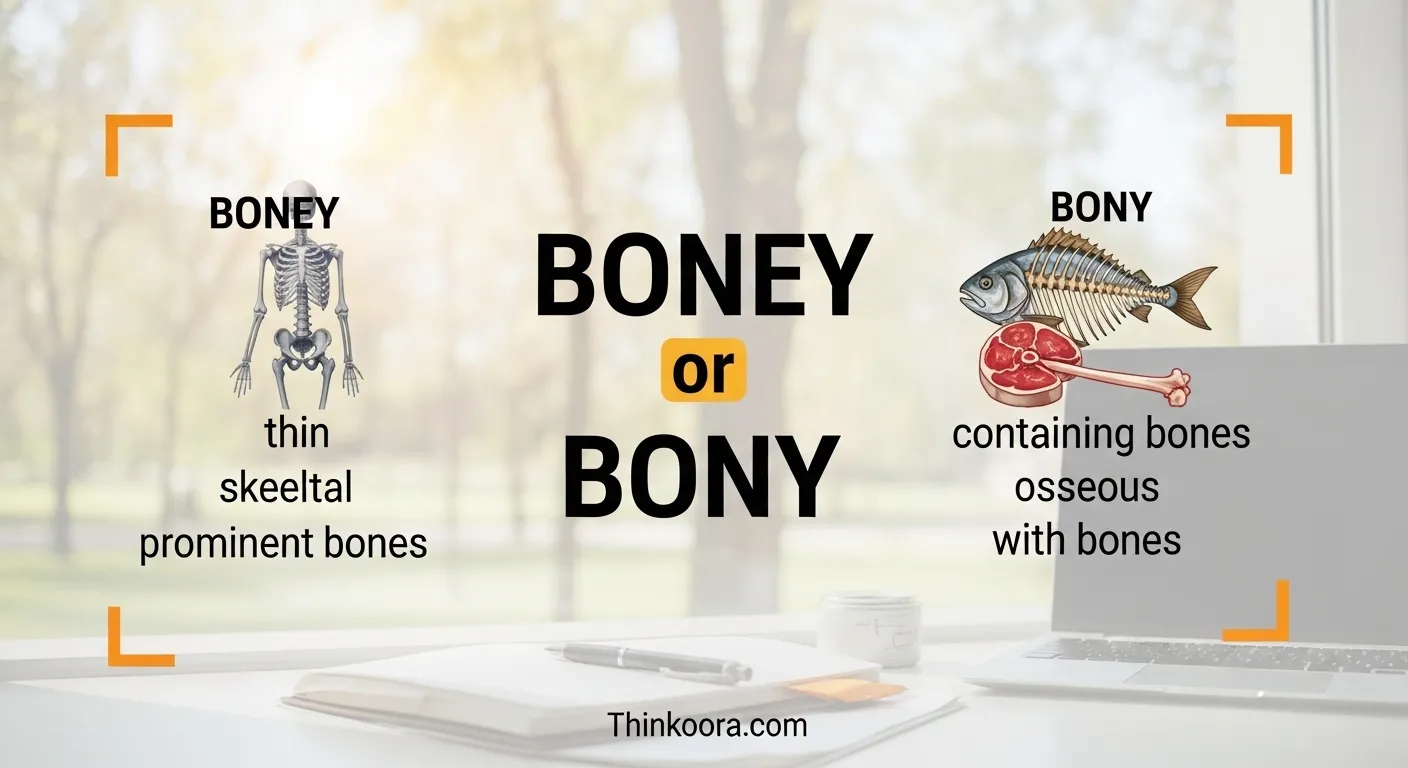
Have you ever typed boney and seen a red underline?
Or wondered if bony looks too short? You are not alone.
Many writers search for boney or bony because both spellings appear online.
This creates doubt. Is one wrong? Are both correct? Does it depend on country?
This confusion often happens with words that end in -y or -ey.
English spelling is not always simple. Some words change by region.
Others have two accepted forms. When writing emails, blog posts, school essays, or news articles, you want the correct spelling.
In this guide, you will get a quick answer first.
Then you will learn the origin of the word, spelling rules in British and American English, common mistakes, and real-life examples.
By the end, you will know exactly when to use boney or bony with confidence.
Boney or Bony – Quick Answer
Both boney and bony are correct.
However, bony is more common in modern English.
Meaning:
Both words describe something full of bones or very thin.
Examples:
- The dog found a bony fish.
- He has a thin, bony face.
- The soup had a boney texture.
In most cases, you should use bony. It is shorter and preferred in formal writing.
The Origin of Boney or Bony
The word comes from the noun bone.
It formed in Middle English by adding the suffix -y, which means full of or like.
- Bone + y = bony
Over time, some writers added an extra e, creating boney. This spelling appeared in older texts. English spelling was less fixed in the past. Many words had variations.
Today, dictionaries list bony as the main spelling. Boney is still accepted, but less common.
British English vs American English Spelling
Unlike words such as color/colour, the difference between boney or bony is not strongly regional.
Both the UK and the US prefer bony.
Still, you may see boney in older British texts.
Comparison Table
| Feature | Bony | Boney |
| Correct spelling | ✅ Yes | ✅ Yes |
| More common today | ✅ Yes | ❌ Less common |
| Preferred in US | ✅ Yes | Rare |
| Preferred in UK | ✅ Yes | Rare |
| Formal writing | ✅ Recommended | Not preferred |
| Informal writing | ✅ Yes | Sometimes |
Which Spelling Should You Use?
Here is simple advice:
- US audience: Use bony
- UK/Commonwealth audience: Use bony
- Global audience: Use bony
If you want safe, professional, and modern English, choose bony.
Use boney only if:
- You are quoting old text
- You prefer a stylistic choice in creative writing
In business, academic, and online writing, bony is best.
Common Mistakes with Boney or Bony
Here are frequent errors:
❌ Mistake 1: Thinking one is completely wrong
Both spellings are correct.
❌ Mistake 2: Mixing both spellings in one article
Be consistent. Choose one.
❌ Mistake 3: Using bone-y with a hyphen
Do not write: bone-y
Correct form: bony
❌ Mistake 4: Confusing meaning
It only relates to bones or thin shape.
It does not mean hard or strong.
Boney or Bony in Everyday Examples
In Emails
- The chicken was too bony to eat comfortably.
In News Writing
- The archaeologists found bony remains in the desert.
On Social Media
- My cat looks so bony after skipping meals!
In Formal Writing
- The patient appeared pale and bony due to illness.
In all professional cases, bony is preferred.
Boney or Bony – Google Trends & Usage Data
Search data shows bony is more popular worldwide.
In countries like:
- United States
- United Kingdom
- Canada
- Australia
The spelling bony appears far more often in books, news, and websites.
People search boney or bony because:
- Spell check flags boney
- Both forms appear online
- They want to avoid mistakes
Modern usage clearly favors bony.
Keyword Comparison Table
| Aspect | Bony | Boney |
| Dictionary standard | Primary form | Secondary form |
| Frequency online | High | Low |
| Academic writing | Preferred | Avoid |
| SEO writing | Recommended | Not ideal |
| Creative writing | Yes | Optional |
FAQs
1. Is boney wrong?
No. It is correct but less common.
2. Which spelling is more modern?
Bony is more modern and widely used.
3. Do Americans use boney?
Rarely. Americans prefer bony.
4. Do British people use boney?
Sometimes in older texts, but bony is standard today.
5. Is bony more formal?
Yes. It is preferred in academic and professional writing.
6. Why does boney exist?
Older English spelling was flexible. Variations developed over time.
7. Should I use both spellings in one article?
No. Stay consistent.
Conclusion
The confusion between boney or bony is common, but the answer is simple.
Both spellings are correct. However, bony is the standard and preferred form in modern English.
It appears more often in dictionaries, news articles, academic texts, and online writing.
The word comes from bone plus the suffix -y, meaning full of bones or thin. Over time, boney appeared as a variation, but it is now less common.
There is no strong British vs American difference here. Both regions prefer bony.
If you write for school, business, blogging, or SEO, choose bony. It is clear, safe, and professional. Use boney only in rare or creative cases.
Now you can write with confidence. No more spelling doubt.
Read More:
Portland or County – Meaning, Usage, and Differences Explained

I’m Daniel Whitmore, a content writer who focuses on English grammar, spelling mistakes, and word usage. I write clear, simple, and helpful articles to make English easier for students, writers, and everyday readers.